































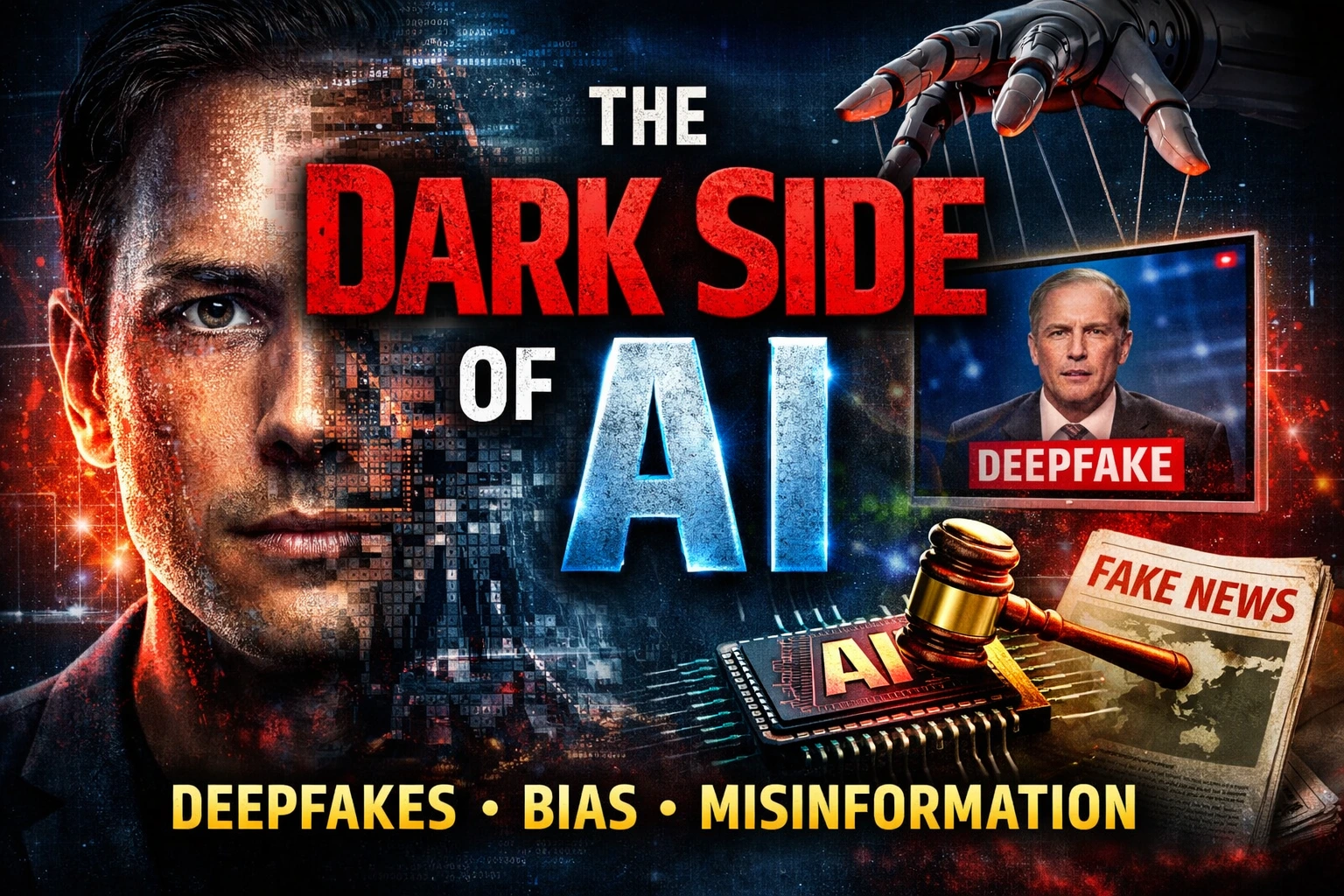


















Artificial intelligence is transforming healthcare, finance, education, and even space research. However, alongside this wave of innovation lies a growing concern: the Dark Side of AI.
For example, in 2023, a deepfake audio recording mimicking a political leader spread rapidly across social media during an election cycle. Within hours, it influenced public opinion before experts confirmed it was fabricated. Similarly, AI-driven hiring systems have been found favoring certain demographics due to biased training data. As a result, these systems unintentionally reinforced existing inequalities.
Taken together, these are not isolated incidents. Rather, they reflect deeper structural vulnerabilities in modern AI systems—ranging from AI deepfakes and algorithmic bias to large-scale misinformation campaigns. Therefore, understanding these risks is essential. In this article, we examine the hidden dangers of artificial intelligence, explore the ethical challenges it presents, and outline what individuals and institutions can do to protect the integrity of truth in a rapidly evolving digital world.
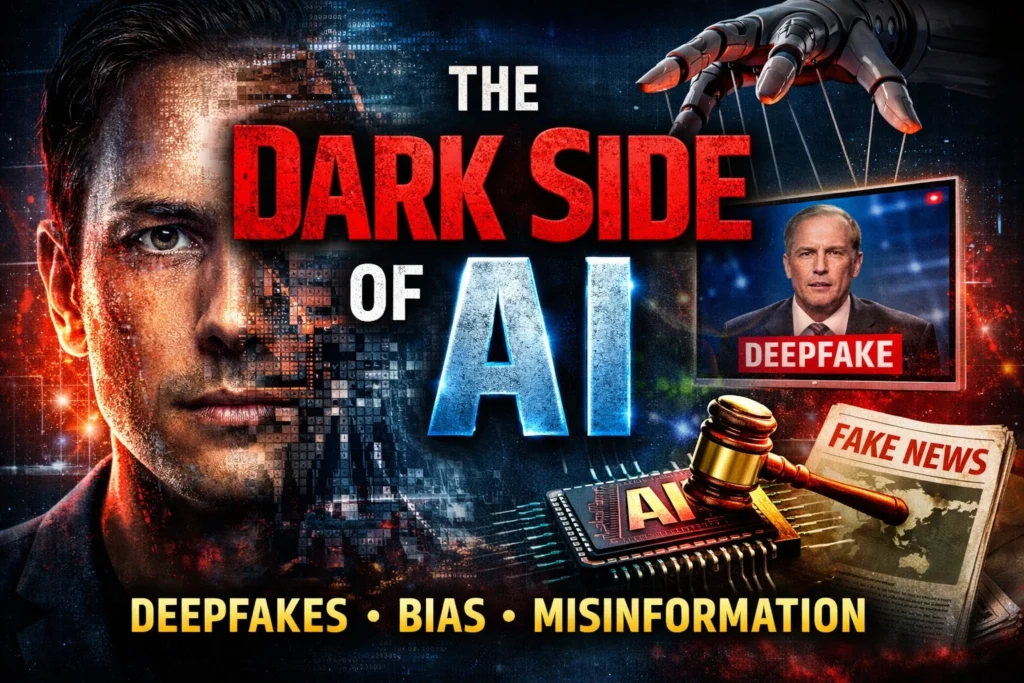
What Is the Dark Side of AI?
The Dark Side of AI refers to the unintended, harmful, or malicious uses of artificial intelligence technologies. While AI drives automation, personalization, and efficiency, it also introduces serious artificial intelligence risks:
- Digital impersonation through deepfakes
- Discriminatory outcomes due to AI bias
- Scalable misinformation campaigns
- Surveillance and privacy violations
- Autonomous decision-making without accountability
AI systems are not inherently malicious. However, they amplify existing human biases, scale misinformation at unprecedented speed, and lower the barrier to sophisticated digital manipulation.
Featured Snippet: What Are the Main Risks of AI?
The main risks of AI include:
- Deepfake-driven deception
- Algorithmic bias and discrimination
- Large-scale misinformation
- Privacy erosion
- Lack of regulatory oversight
These risks form the foundation of the modern debate around AI ethics and regulation.
Deepfakes – Technology Behind the Illusion
Few technologies symbolize the Dark Side of AI more vividly than deepfakes.
How AI Deepfakes Work
Deepfakes are synthetic media created using deep learning techniques, particularly Generative Adversarial Networks (GANs) or transformer-based generative models.
In simplified terms:
- A model is trained on thousands of images or audio samples of a target.
- The AI learns facial movements, speech patterns, and expressions.
- It generates realistic but fake video, audio, or images.
- Advanced editing tools refine realism.
Modern AI deepfakes can replicate:
- Voice tone and cadence
- Facial micro-expressions
- Eye movement and blinking patterns
- Emotional nuance
The result is hyper-realistic digital manipulation that can deceive even trained observers.
Real-World Cases of AI Deepfakes
- Political Manipulation: Synthetic videos of political figures have circulated during election cycles globally.
- Financial Fraud: In 2019, criminals used AI-generated voice cloning to impersonate a CEO and fraudulently transfer $243,000.
- Celebrity Exploitation: Non-consensual deepfake content has targeted public figures.
- Corporate Sabotage: Fake executive announcements have impacted stock prices.
According to cybersecurity research, deepfake-related fraud attempts increased more than 10x between 2022 and 2024.
Political and Social Risks
Deepfakes pose systemic risks:
- Erosion of trust in video evidence
- Election interference
- Reputation destruction
- Blackmail and extortion
- Diplomatic instability
Perhaps the most dangerous consequence is what scholars call the “liar’s dividend.” When real footage surfaces, individuals can dismiss it as fake, undermining accountability.
In a world flooded with synthetic media, truth itself becomes negotiable.
AI Bias – When Algorithms Discriminate
Another critical dimension of the Dark Side of AI is bias embedded within algorithms.
How Bias Enters AI Systems
AI models learn from historical data. If that data reflects societal inequities, the AI system internalizes and perpetuates them.
Bias enters through:
- Skewed training datasets
- Imbalanced representation
- Biased labeling practices
- Feedback loops reinforcing discrimination
- Design assumptions by developers
This phenomenon is known as algorithmic bias.
Real Examples in Hiring, Policing, and Finance
AI bias is not theoretical—it has produced measurable, real-world consequences across critical sectors. These cases illustrate how algorithmic bias can quietly shape life-altering decisions.
Hiring: When AI Reinforces Historical Inequality
Several organizations adopted AI-powered recruitment tools to streamline resume screening and candidate evaluation. These systems were trained on historical hiring data—often spanning years of past recruitment decisions.
The problem? Historical hiring patterns reflected existing workplace imbalances.
In one widely reported case, a large technology company discontinued its AI recruitment tool after internal audits revealed it was systematically favoring male applicants. The system had learned from past hiring data dominated by male candidates, and as a result:
- Resumes containing terms more commonly associated with women were downgraded.
- Graduates from women’s colleges were penalized.
- Technical roles were implicitly modeled around male-dominated historical patterns.
The algorithm did not “intend” discrimination. It optimized based on historical success data. However, when past data encodes gender imbalance, AI models amplify it.
Structural Insight:
AI hiring systems can unintentionally reward similarity to past hires rather than objective talent metrics. Without fairness constraints and regular audits, automated recruitment can replicate legacy bias at scale.
Policing: Predictive Systems and Disproportionate Targeting
Predictive policing tools use historical crime and arrest data to identify potential crime hotspots, aiming to improve resource allocation. However, because past data often reflects uneven enforcement patterns, these systems can disproportionately target minority neighborhoods, reinforcing existing biases rather than objectively predicting crime.
In several regions, investigative reports and academic studies found that predictive policing systems disproportionately directed patrols toward minority neighborhoods. This occurred because:
- Historical arrest records were concentrated in certain communities.
- Over-policing in specific areas produced more recorded incidents.
- The AI system interpreted higher recorded crime as higher future risk.
This creates a feedback loop:
- Increased patrol presence leads to more recorded incidents.
- More data reinforces the model’s prediction.
- The system justifies continued disproportionate targeting.
The outcome is not just data distortion—it can shape community relations, civil liberties, and public trust.
Structural Insight:
Predictive models do not distinguish between actual crime prevalence and enforcement intensity. If enforcement patterns are biased, the AI system learns and institutionalizes that bias.
Finance: Disparities in Lending and Credit Decisions
Financial institutions increasingly use AI systems to assess creditworthiness, determine loan approvals, and set interest rates. These models analyze large datasets including credit history, income, spending patterns, and sometimes alternative behavioral data.
Research has shown that automated lending systems can produce disparate outcomes across demographic groups—even when financial profiles appear comparable.
Examples include:
- Higher interest rates offered to minority applicants with similar credit scores.
- Increased loan rejection rates in specific zip codes correlated with socioeconomic factors.
- Use of proxy variables (such as geographic location) that indirectly encode racial or economic disparities.
In many cases, these disparities emerge not from explicit demographic inputs but from correlated variables embedded in historical financial data.
Because modern AI models often function as “black boxes,” identifying the precise source of bias can be technically complex.
Structural Insight:
Financial AI systems optimize for risk minimization. If historical lending data reflects unequal access to credit or systemic inequality, AI models may perpetuate those patterns unless corrected with fairness-aware modeling techniques.
Why These Cases Matter
These are not isolated technical failures. They represent broader structural challenges:
- Historical data is not neutral.
- Optimization objectives may conflict with fairness.
- Feedback loops can amplify inequality.
- Opacity reduces accountability.
When AI systems influence employment, policing, and financial access, they directly impact economic mobility, civil rights, and social equity.
Addressing AI bias requires:
- Diverse and representative training datasets
- Ongoing bias audits and impact assessments
- Explainable AI frameworks
- Clear accountability structures
- Regulatory oversight where appropriate
Artificial intelligence can enhance efficiency and consistency—but without deliberate safeguards, it can also automate and scale inequality.
Understanding these examples is essential to confronting the deeper ethical challenges embedded in modern AI systems.
Ethical Implications of AI Bias
The ethical implications are profound:
- Reinforcement of systemic discrimination
- Reduced transparency in decision-making
- Erosion of due process
- Loss of public trust
AI ethics demands:
- Fairness audits
- Explainability mechanisms
- Diverse training datasets
- Inclusive development teams
Without oversight, AI systems risk codifying inequality at scale.
Misinformation & The Crisis of Truth
The convergence of generative AI and social media has accelerated the spread of misinformation.
AI-Generated Fake News
Large language models can produce:
- Fabricated news articles
- Synthetic academic citations
- False product reviews
- Fake press releases
These outputs can appear authoritative and structured, making detection increasingly difficult.
Featured Snippet: How Does AI Contribute to Misinformation?
AI contributes to misinformation by:
- Generating realistic fake content at scale
- Automating bot-driven distribution
- Personalizing propaganda
- Lowering cost of content manipulation
Social Media Amplification
Algorithms prioritize engagement. Sensational or polarizing content often performs better.
This creates a feedback loop:
- AI generates misleading content.
- Social platforms amplify high-engagement posts.
- Users reshare without verification.
- False narratives gain legitimacy.
A 2024 study found that misinformation spreads up to 6 times faster than factual content on major platforms.
The issue is not only content creation—but algorithmic amplification.
Human-Created vs AI-Generated Content Risks
| Risk Factor | Human-Created Content | AI-Generated Content |
| Scale | Limited by manpower | Mass production in seconds |
| Personalization | Moderate | Hyper-personalized at scale |
| Speed | Slower creation | Instant generation |
| Detectability | Easier to trace | Increasingly difficult |
| Cost | Higher | Extremely low |
AI magnifies the impact and efficiency of misinformation campaigns.
Legal & Ethical Battle
As artificial intelligence risks escalate, governments and institutions are responding.
AI Regulation Efforts
Several jurisdictions are introducing regulatory frameworks:
- Risk-based AI classification systems
- Mandatory transparency for high-risk AI
- Deepfake disclosure requirements
- Fines for non-compliance
Regulatory approaches focus on:
- Accountability
- Transparency
- Human oversight
- Risk mitigation
However, regulation struggles to keep pace with rapid AI innovation.
Role of Governments and Tech Companies
Governments Must:
- Establish enforceable AI standards
- Fund independent research
- Promote international coordination
- Protect civil liberties
Tech Companies Must:
- Conduct algorithmic audits
- Implement watermarking for AI content
- Increase transparency in model training
- Prioritize AI ethics over speed-to-market
The battle for truth is both technological and institutional.
How Individuals Can Protect Themselves
While systemic solutions are critical, individuals also play a role.
1. Verify Before Sharing
Use multiple reputable sources before reposting.
2. Examine Visual Clues
Deepfakes may still show:
- Unnatural blinking
- Inconsistent lighting
- Audio sync mismatches
3. Strengthen Digital Literacy
Understand how AI-generated content works.
4. Use Fact-Checking Tools
Leverage verification platforms and reverse image searches.
5. Protect Personal Data
Limit publicly available photos and voice recordings to reduce misuse risk.
Digital awareness is now a civic responsibility.
Pros and Cons of AI Development
Pros
- Increased productivity
- Medical advancements
- Enhanced scientific research
- Automation of repetitive tasks
- Personalized education
Cons
- AI bias and discrimination
- Deepfake-driven deception
- Job displacement
- Privacy erosion
- Escalating misinformation
The challenge is not halting AI—but guiding it responsibly.
Frequently Asked Questions (FAQ)
1. What is the Dark Side of AI?
It refers to the harmful applications of AI, including deepfakes, bias, misinformation, and privacy violations.
2. Are AI deepfakes illegal?
Legality varies by jurisdiction. Some regions criminalize malicious deepfake use, especially in elections or non-consensual content.
3. Can AI systems be unbiased?
AI can be made fairer through careful dataset design, audits, and monitoring, but complete neutrality is difficult.
4. How can deepfakes be detected?
Detection uses forensic AI tools analyzing pixel inconsistencies, metadata, and audio artifacts.
5. Is AI regulation slowing innovation?
Well-designed regulation aims to reduce harm while encouraging responsible innovation.
6. Does AI always spread misinformation?
No. AI can also help detect misinformation, but it can be misused to generate it.
7. What industries face the highest AI risks?
Politics, finance, media, hiring, and law enforcement are particularly vulnerable.
📌 Key Takeaways
- The Dark Side of AI includes deepfakes, bias, and misinformation.
- AI deepfakes threaten trust in visual evidence.
- Algorithmic bias can reinforce discrimination.
- Social media amplifies AI-generated misinformation.
- Regulation and AI ethics are central to future governance.
- Individuals must strengthen digital literacy to navigate AI risks.
Conclusion: The Battle for Truth in the Age of AI
Artificial intelligence is neither inherently good nor evil. It reflects the values, data, and incentives embedded within it.
The Dark Side of AI emerges when technological capability outpaces ethical oversight. Deepfakes distort reality. Algorithmic bias replicates inequality. Misinformation destabilizes democratic institutions.
Yet the same AI systems driving these risks also power medical breakthroughs, climate modeling, and scientific discovery.
The future depends on balance:
- Responsible AI development
- Transparent governance
- Cross-border regulatory cooperation
- Public digital literacy
The battle for truth is not about resisting AI. It is about ensuring that innovation strengthens society rather than fragments it.
Suggested Internal Links