Physical Address
Mumbai, Maharashtra - 400037
Physical Address
Mumbai, Maharashtra - 400037

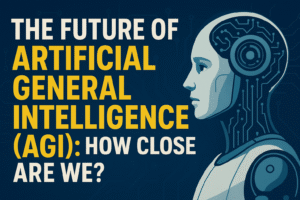
Artificial Intelligence (AI) is already transforming our world — from chatbots to self-driving cars. But the next frontier, Artificial General Intelligence (AGI), aims to go beyond — a form of AI that can think, reason, and learn just like humans. The question is, how close are we to achieving it ? Let’s explore the science, progress, challenges, and predictions shaping the future of AGI.
What is Artificial General Intelligence (AGI)?
Artificial General Intelligence (AGI) refers to a type of AI capable of performing any intellectual task that a human can. Unlike today’s “narrow AI” — which excels at specific tasks such as translation, image recognition, or playing chess — AGI would possess broad, adaptable intelligence. It could understand, reason, and learn across multiple domains without needing to be retrained from scratch.
For example, a narrow AI can beat humans in chess but cannot write a poem or design an app. An AGI, on the other hand, could do all of these — demonstrating true general understanding.
The Evolution of AI: From Narrow to General
The journey toward AGI began in the 1950s, when early researchers dreamed of creating machines that could “think.” Over the decades, AI has evolved through several stages:
– Rule-Based Systems (1950s–1980s): Early programs that followed strict logic-based rules.
– Machine Learning (1990s–2010s): Systems that learn from data rather than being explicitly programmed.
– Deep Learning (2012–present): Neural networks capable of understanding patterns in images, speech, and text.
Breakthroughs like OpenAI’s GPT models, Google DeepMind’s AlphaGo, and Anthropic’s Claude have brought AI closer to mimicking human intelligence. Each leap narrows the gap between human and machine cognition.
How AGI Might Work
Creating AGI requires more than just bigger data or faster computers. It involves combining multiple disciplines of science and computing, including:
– Neural Networks & Large Language Models: Mimicking human neural processing.
– Reinforcement Learning: Teaching AI through trial and error, similar to human learning.
– Cognitive Architectures: Designing systems that imitate human memory, perception, and reasoning.
– Quantum Computing (Future Potential): Unlocking computational power beyond today’s limits.
Researchers are striving to design algorithms that can learn from a few examples, understand context, and self-improve over time — the very hallmarks of human intelligence.
Current Progress Toward AGI
In recent years, companies like OpenAI, Google DeepMind, and Anthropics have made astonishing progress. Models such as GPT-5, Gemini, and Claude 3 demonstrate abilities like complex reasoning, creativity, and problem-solving.
However, even the most advanced AI systems today lack true understanding, self-awareness, and consciousness. They process information statistically, not emotionally or intuitively like humans do. This gap — between intelligence and understanding — remains the biggest obstacle on the road to AGI.
Challenges in Building AGI
Building AGI is not just a technical challenge — it’s a philosophical and ethical one too. Here are the major hurdles:
1. Technical Challenges:
AGI requires massive computational power, efficient algorithms, and systems that can generalize knowledge across tasks — something current AI struggles with.
2. Ethical Challenges:
Who controls AGI? How do we prevent misuse, bias, or unethical behavior? Ensuring AI alignment — making sure AI’s goals match human values — is one of the toughest problems in modern science.
3. Philosophical Challenges:
Can machines ever be conscious? What does it mean for a system to “understand”? These questions blur the line between technology and humanity.
Even if we can build AGI, should we? Ensuring safety and control is as important as the innovation itself.
Predictions: When Will AGI Arrive?
Experts are divided. Some believe AGI could emerge as early as 2030, driven by rapid advances in AI research and computing power. Others argue we’re decades or even centuries away, citing fundamental gaps in our understanding of human cognition.
Forecasts vary widely:
– Optimists (like Ray Kurzweil) predict AGI by the 2040s.
– Skeptics argue it may never happen — at least not in a way that resembles human thought.
The truth is, no one knows. But progress is accelerating faster than ever before, making the 21st century a potential turning point for AI evolution.
The Impact of AGI on Society
If AGI becomes reality, it could reshape human civilization in ways we can hardly imagine:
– Economic Impact: Automation could replace millions of jobs but also create new industries we can’t yet foresee.
– Scientific Progress: AGI could accelerate research in medicine, climate change, and space exploration.
– Risks and Threats: Uncontrolled AGI could pose existential dangers — from misinformation to autonomous decision-making beyond human control.
As with every technological revolution, the benefits and risks will depend on how we choose to use it.
Ethical and Safety Considerations
Building AGI isn’t just a race for innovation — it’s a test of responsibility. Key concerns include:
-AI Alignment:Ensuring AGI systems act according to human ethics and values.
– Regulation and Oversight: Governments must create global frameworks to monitor AGI development.
-Transparency: Developers must ensure AGI decisions are understandable and accountable.
Without ethical guardrails, AGI could become unpredictable — or even dangerous. Collaboration between nations, scientists, and policymakers is essential to keep development safe and beneficial.
The Road Ahead
The road to AGI is filled with both excitement and uncertainty. The progress we’ve seen so far — from intelligent assistants to creative AI — shows that human-like reasoning is no longer a fantasy. However, the real challenge lies in balancing innovation with wisdom.
The race for AGI is not about who builds it first, but who builds it safely, ethically, and for the good of all. As researchers push boundaries, humanity must unite to ensure AGI becomes a tool for empowerment, not domination.
Conclusion
Artificial General Intelligence could become the most powerful invention in human history. Whether it becomes our greatest ally or a dangerous rival depends entirely on **how we shape its journey today.
AGI holds the promise to solve problems once thought impossible — but it also carries the potential to redefine what it means to be human. The future of AGI is not just about smarter machines — it’s about a smarter humanity.