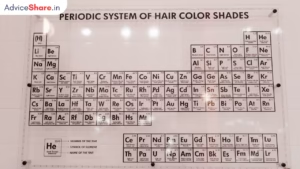
🔹 General Facts about Elements Elements are pure substances that cannot be broken down by chemical means. The building blocks of elements are atoms. Each element is defined by its number of protons (atomic number). There are 118 known elements in the periodic table. Out of these, 94 occur naturally on Earth. The rest are synthetic (man-made) in laboratories. Hydrogen is the lightest element. Oganesson (Og, element 118) is the heaviest element discovered so far. Oxygen is the most abundant element in the Earth’s crust. About 96% of the human body is made up of just 4 elements: oxygen, carbon, hydrogen, and nitrogen. 🔹 History of Elements The concept of elements dates back to ancient Greece (earth, water, air, fire). Antoine Lavoisier is considered the “Father of Modern Chemistry.” Dmitri Mendeleev created the first modern periodic table in 1869. Mendeleev predicted the discovery of new elements. Helium was first discovered in the Sun before being found on Earth. Gold and copper were among the first metals used by humans. Ancient alchemists tried to turn lead into gold. The word “element” comes from the Latin elementum. Most elements are named after scientists, places, or mythological references. The periodic table organizes elements by atomic number and properties. 🔹 Periodic Table Facts The periodic table has 7 periods (rows) and 18 groups (columns). Metals are on the left, non-metals on the right. Noble gases (Group 18) are chemically inert. Alkali metals (Group 1) are highly reactive. Alkaline earth metals (Group 2) are also reactive but less than alkali metals. Transition metals occupy the center of the table. Lanthanides and actinides are placed separately at the bottom. Halogens (Group 17) are very reactive non-metals. Periodic trends include atomic radius, electronegativity, and ionization energy. Fluorine is the most electronegative element. 🔹 Natural Elements Hydrogen is the most abundant element in the universe. Helium is the second most abundant. Iron is the most abundant element in Earth’s core. Oxygen makes up about 21% of Earth’s atmosphere. Silicon is the second most common element in the Earth’s crust. Uranium is the heaviest naturally occurring element. Carbon exists in multiple forms (allotropes), including diamond and graphite. Sulfur is known as “the brimstone” in ancient texts. Nitrogen makes up 78% of Earth’s atmosphere. Phosphorus is essential for DNA and ATP. 🔹 Synthetic Elements Elements above uranium (atomic number 92) are called transuranium elements. Plutonium was first produced in 1940. Many synthetic elements are unstable and radioactive. Oganesson (Og) was discovered in 2002. Americium is used in smoke detectors. Curium was named after Marie Curie. Einsteinium was named after Albert Einstein. Nobelium was named after Alfred Nobel. Some synthetic elements exist only for a few seconds. Scientists continue to try to create elements beyond 118. 🔹 Everyday Uses of Elements Iron is used in construction and tools. Aluminum is used in cans and airplanes. Copper is used in electrical wiring. Carbon is found in fuels and plastics. Gold is used in jewelry and electronics. Silver is used in coins and photography. Lithium is used in rechargeable batteries. Silicon is used in computer chips. Titanium is used in spacecraft and implants. Helium is used in balloons and MRI machines. 🔹 Biological Importance Carbon is the basis of all life. Oxygen is needed for respiration. Nitrogen is essential for proteins and DNA. Calcium is important for bones and teeth. Potassium helps regulate nerve signals. Sodium controls fluid balance. Iron is vital for hemoglobin in blood. Magnesium is essential for photosynthesis. Phosphorus is part of DNA and cell membranes. Trace elements like zinc and iodine are vital in small amounts. 🔹 Fun & Strange Facts Mercury is the only metal that is liquid at room temperature. Gallium melts in your hand. Francium is the rarest naturally occurring element. Helium was discovered during a solar eclipse. Tungsten has the highest melting point of all metals. Hydrogen can exist as a metallic solid under extreme pressure. Neon signs glow due to excited neon gas. Radium glows in the dark due to radioactivity. Argon makes up about 1% of Earth’s atmosphere. Cobalt is used to make blue pigments. 🔹 Radioactive Elements Uranium is used in nuclear power plants. Plutonium is used in nuclear weapons. Radon is a radioactive gas found in some homes. Thorium can be used as an alternative nuclear fuel. Polonium is extremely toxic and radioactive. Cesium is highly reactive and used in atomic clocks. Radioactive isotopes are used in medicine. Half-life measures how long it takes for radioactivity to decay. Technetium was the first artificially produced element. Radioactive tracers help in diagnosing diseases. 🔹 Future & Discovery Scientists are searching for an “island of stability” in superheavy elements. Element 119 and 120 are the next targets for discovery. Superheavy elements may have unexpected properties. New elements are created by colliding atomic nuclei. Particle accelerators are used for element discovery. The search for new elements is international. Some new elements exist only in particle detectors. Periodic table may expand further. Understanding elements helps in space exploration. 100. Elements are the foundation of all chemistry and life. Reader: 690Contents1. 🔹 General Facts about Elements2. 🔹 Periodic Table Facts3. 🔹 Natural Elements4. 🔹 Synthetic Elements5. 🔹 Everyday Uses of Elements6. 🔹 Biological Importance7. 🔹 Fun & Strange Facts8. 🔹 Radioactive Elements9. 🔹 Future & Discovery Share on Facebook Share on LinkedIn Share on WhatsApp Share on Telegram Copy to Clipboard Previous Post 100 facts about Education & Learning in English Next Post 100 facts about Innovation & Technology in English