Physical Address
Mumbai, Maharashtra - 400037

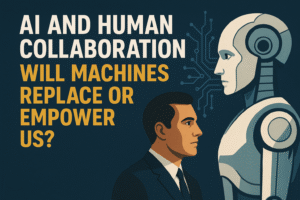
Imagine walking into your office and finding out your newest team member isn’t human — it’s an AI system capable of analyzing data, writing reports, or even designing presentations. Sounds like science fiction? It’s today’s reality. Artificial Intelligence (AI) is no longer just a futuristic idea; it’s woven into our daily lives, from the recommendations we see on Netflix to the chatbots that help us online.
But as AI grows smarter, the big question arises: will machines replace us, or will they empower us to reach new heights?

AI has come a long way from being a simple automation tool. In the early days, machines could perform only repetitive, rule-based tasks — think assembly lines and calculators. Today, AI systems like ChatGPT, Midjourney, and AlphaFold can learn, reason, and even create.
This transformation is driven by machine learning and deep neural networks that allow computers to process complex data patterns and improve over time. In essence, AI has evolved from being a tool that executes commands to a partner that generates insights.
Whenever technology advances, fear of replacement follows. From the industrial revolution to the internet boom, humans have worried about machines making them obsolete. AI has reignited this concern.
A 2023 report by the World Economic Forum estimated that around 85 million jobs could be displaced by automation — yet, at the same time, 97 million new roles may emerge that require human-AI collaboration.
It’s crucial to understand that AI tends to replace tasks, not entire jobs. For instance:
The takeaway? Jobs will change, not vanish.
Instead of asking whether AI will replace us, a better question is: how can AI help us do better work?
AI excels at handling massive datasets, recognizing patterns, and executing repetitive processes — tasks that often drain human time and focus. Humans, on the other hand, bring qualities AI can’t replicate: empathy, ethics, creativity, and emotional understanding.
Let’s see how this partnership works in real-world scenarios:
Together, humans and AI form a synergistic duo — machines handle the heavy lifting while humans steer the ship.
AI is already reshaping multiple sectors — not by replacing people, but by amplifying human potential.
These examples show that AI can be a force multiplier when aligned with human goals.
5. The Future of Work: From Replacement to Reinvention
The future won’t be about humans versus machines — it’ll be about humans with machines.
As AI becomes more integrated into the workplace, the demand for new skills will rise:
In this evolving landscape, humans are shifting from task executors to strategic collaborators — guiding AI systems, setting objectives, and ensuring ethical use.
Collaboration also brings responsibility. AI systems learn from data, and biased data can lead to biased results. Humans must ensure that AI tools are transparent, fair, and accountable.
Ethical AI development includes:
In short, humans must remain the moral compass behind AI innovation.
Conclusion: Empowerment, Not Erasure
So, will machines replace us?
The answer depends on how we choose to use them.
If we see AI as competition, we risk losing sight of its potential. But if we embrace it as a partner, we open doors to innovation, creativity, and efficiency like never before.
The future belongs to those who can collaborate with technology, not fear it.
AI won’t replace you. A person using AI will.
What do you think?
Do you see AI as a threat to jobs or as a tool for empowerment?
Share your thoughts in the comments — and let’s shape the future of human-AI collaboration together.





This is such a fascinating topic! I personally believe AI isn’t here to replace humans but to amplify what we’re capable of. When humans and machines collaborate effectively, creativity and efficiency reach new heights.