Physical Address
Mumbai, Maharashtra - 400037
Physical Address
Mumbai, Maharashtra - 400037

Exploring how artificial intelligence is reshaping art, creativity, and the future of human expression.
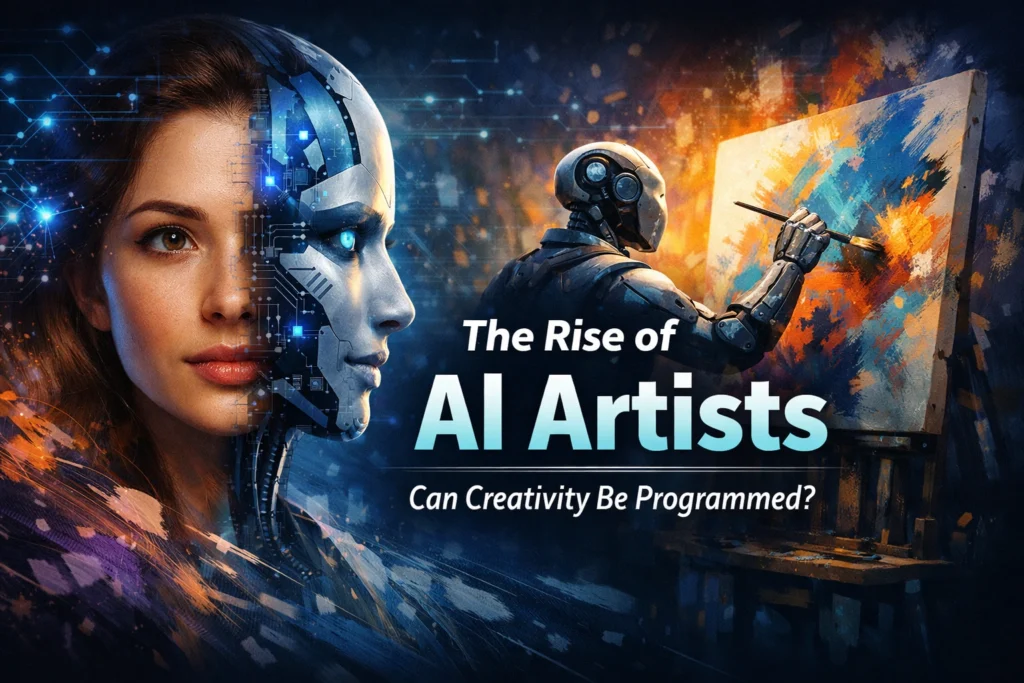
In recent years, images painted by algorithms, music composed by machines, and poems written by artificial intelligence have flooded social media, galleries, and digital platforms. AI-generated artworks are winning competitions, selling at auctions, and being used in branding campaigns by global companies. What once felt like science fiction has quickly become a visible and influential part of modern creative culture.
These creators, often referred to as AI artists, are not humans in the traditional sense. They do not hold brushes, feel emotions, or experience inspiration the way people do. Instead, they are systems powered by complex algorithms that generate outputs resembling human-made art. Yet their results are often convincing enough to spark admiration, controversy, and concern in equal measure.
This shift matters now more than ever because of three powerful forces: accessibility, speed, and scale. AI tools allow almost anyone to generate high-quality visuals, music, or text within seconds. Tasks that once required years of training can now be initiated with a simple prompt. As a result, the boundaries between professional artists and casual creators are becoming increasingly blurred.
At the heart of this transformation lies a fundamental question that challenges centuries of artistic philosophy: Is creativity uniquely human, or can it be programmed? This article explores that question by examining how AI creates art, how creativity is defined, the opportunities and risks involved, and what the future may hold for human and machine collaboration.
AI artists are not individuals but systems designed to generate creative outputs such as images, music, videos, and written content. Their “artistry” is derived from computational processes rather than lived experience.
At a foundational level, AI-generated art relies on machine learning and neural networks. These systems are trained on massive datasets containing millions (sometimes billions) of examples of human-created work. This training allows the AI to identify patterns, structures, and relationships within the data.
For example:
When a user provides a prompt, the AI does not “think” or “imagine” in a human sense. Instead, it predicts what output is statistically most likely to match the input based on everything it has learned. This distinction is critical. AI does not originate ideas from personal experience; it recombines existing patterns in novel ways.
This leads to an ongoing debate: if creativity is about producing something new and meaningful, does recombination qualify as true creation?
Several AI systems have become widely known for their creative capabilities, including:
Despite their differences, all follow a similar workflow: Prompt → Model Processing → Generated Output. The creativity appears in the output, but the process remains fundamentally computational.
The idea of machines producing art is not new. As early as the 1960s, artists and engineers experimented with computers to create geometric drawings and algorithmic patterns. These early systems followed strict, rule-based instructions and produced predictable results.
During the late 20th century, generative art gained momentum. Artists wrote algorithms that introduced randomness, allowing computers to generate variations within defined constraints. While visually interesting, these works were clearly mechanical and lacked the depth associated with human creativity.
Modern AI differs dramatically from these earlier systems. Instead of following explicit rules, today’s models learn from data. They infer rules implicitly rather than being programmed line by line. This shift explains why contemporary AI outputs feel more organic, expressive, and “creative” than earlier computer art.
What has changed is not the machine’s intention, but its capacity to model complexity at a scale previously impossible.
To evaluate whether AI can truly be creative, we must first understand what creativity means.
Creativity is often described as the ability to produce work that is both original and meaningful. However, most definitions also include deeper human elements:
Human creativity is shaped by memory, emotion, failure, curiosity, and lived reality. Artists draw from joy, pain, conflict, and identity—elements that give their work meaning beyond aesthetics.
AI can produce originality in form, but not in intent. Its outputs may appear novel, but they are derived entirely from existing data. AI does not feel emotion, understand cultural significance, or possess self-awareness.
This leads to a key distinction: AI recombines, humans inspire. While an AI can generate a painting that resembles sadness, it does not understand sadness itself.
“AI doesn’t imagine—it predicts.”
Whether prediction alone qualifies as creativity remains a philosophical question, but most scholars agree that creativity without consciousness is fundamentally different from human creation.
AI art is no longer theoretical—it is actively shaping industries.
AI-generated artworks have been sold at prestigious auctions, sometimes for unexpectedly high prices. In music, composers are using AI to generate melodies that they later refine. In branding and marketing, companies rely on generative design tools to produce logos, illustrations, and advertising visuals at scale.
In most cases, AI acts as a collaborator, not a replacement. Designers guide the system, curate outputs, and apply human judgment. However, public reactions remain mixed. Some celebrate AI as an innovative tool, while others see it as a threat to artistic authenticity.
The controversy itself reflects how deeply art is tied to identity and human value.
Despite the debate, AI offers undeniable advantages in creative work.
Rather than replacing creativity, AI often amplifies it—especially when used as a starting point rather than a final authority.
One of the most pressing concerns is ownership. If an AI generates an artwork, who owns it? The user? The developer? Or the artists whose work trained the model?
Training datasets often include copyrighted material, raising ethical questions about consent and compensation.
Designers, illustrators, and writers worry about reduced demand for human labor. While AI may not eliminate creative jobs entirely, it is reshaping skill requirements. Adaptability is becoming more important than mastery of a single tool.
Art has traditionally been valued for its human connection. When a machine produces art, some argue that emotional depth is lost. Others believe meaning comes from the viewer, regardless of the creator.
At its core, creativity involves more than producing output—it involves experience. AI can simulate creative processes but cannot live through moments, emotions, or social realities.
AI depends entirely on human-created data. Without people, it has nothing to learn from. This dependency highlights its limitations.
The philosophical debate centers on one distinction: simulation versus genuine creativity. AI may convincingly simulate creative outcomes, but it does not experience creativity itself.
A balanced conclusion is unavoidable: AI can simulate creativity, but it cannot experience it.
The future is unlikely to be a battle between humans and machines. Instead, it points toward collaboration.
AI will increasingly handle repetitive or exploratory tasks, while humans focus on vision, storytelling, ethics, and emotional depth. Education will shift toward conceptual thinking, creative direction, and critical judgment.
Artists who learn to work with AI—not against it—will define the next era of creativity.
Over the next 5–10 years, creativity will become less about technical execution and more about meaning, intention, and perspective.
The rise of AI artists challenges long-held assumptions about creativity. While machines can generate impressive outputs, they do not replace the human capacity for meaning, emotion, and intention.
Creativity is no longer a solo act—it is becoming a shared space between humans and intelligent tools. History shows that tools never eliminate artists; they redefine what artists do.
The question is no longer whether AI can create art, but how humans choose to use it.