Physical Address
Mumbai, Maharashtra - 400037
Physical Address
Mumbai, Maharashtra - 400037

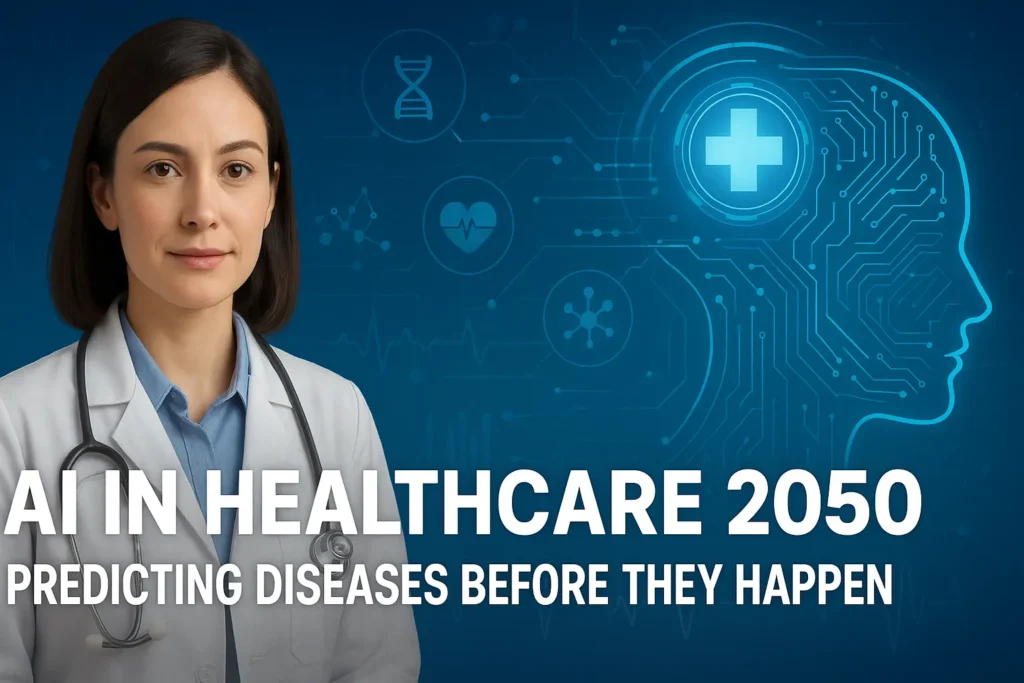
How continuous monitoring, multi-omics, digital twins, and privacy-first AI will turn reactive care into anticipatory medicine.
It’s 7:10 AM in New Delhi, the year is 2050. Aarav, a 42-year-old software engineer, is getting ready for work when his smart health patch vibrates gently on his arm.
A notification appears on his wall-mounted health dashboard:
“Your cardiac digital twin predicts a 68% chance of micro-arterial stress within 48 hours. Please hydrate, skip caffeine today, and start the recommended anti-inflammatory protocol.”
Aarav isn’t sick. He feels perfectly fine.
Yet, his AI-driven health ecosystem has detected microscopic physiological trends—subtle changes in blood biomarkers, heart variability patterns, sleep rhythms, and environmental exposures—that even the most skilled doctor would never catch in time.
This is not science fiction anymore.
This is the future of healthcare in 2050: not curing diseases after they appear, but predicting and preventing them before they begin.
Thesis:
By 2050, AI won’t just assist doctors — it will forecast illness windows and enable preemptive interventions that could save millions of lives.
Today’s healthcare system is mostly reactive.
We wait for symptoms, rush to hospitals, undergo costly procedures, and hope for recovery. This delay leads to:
But prediction changes everything.
Predictive healthcare takes us from “What is wrong?” to “What may go wrong—and how do we stop it?”
The future of predictive medicine rests on several powerful, interconnected technologies.
In 2050, health data flows from:
Every heartbeat, breath, movement, and chemical signal becomes a data point.
Example:
Your living room air sensor detects increased pollutants → wearable notices slight inflammation → AI predicts future respiratory stress → your environment adjusts automatically.
Your health story isn’t just physical—it’s biological at multiple layers:
Combine this with a complete longitudinal electronic health record, and AI can see patterns across years—not just weeks.
A digital twin is a real-time computer model of your:
It’s like having a virtual version of yourself running simulations:
Doctors of 2050 treat the twin before the actual patient.
Your data stays with you.
AI models learn collaboratively across hospitals without sharing raw patient data, thanks to:
This preserves confidentiality while enabling countries to build global disease-prediction systems.
Unlike traditional AI, which spots correlations, causal AI answers:
This makes AI explainable, trustworthy, and clinically reliable.
By 2050:
Meaning predictions happen before the danger grows.
AI will predict:
Days or even weeks before symptoms.
Subtle changes in:
will help detect diseases 10–15 years before onset.
Using:
AI can predict outbreaks before the first hospital case.
Ultra-sensitive analysis of:
will catch cancer in stage 0 or stage 1 — virtually eliminating late-stage diagnoses.
AI will recognize early signs of:
by analyzing sleep, energy levels, typing behavior, and social interaction.
Maya’s digital twin detected unusual blood flow turbulence.
Her wearable confirmed inflammation biomarkers.
AI predicted a 72% chance of minor stroke within 3 days.
Doctors intervened early with medication + rest.
Result: A stroke that never happened.
“AI proposes. Clinicians validate. Patients choose.”
Control remains with the human — always.
Predictive healthcare is powerful—and dangerous if misused.
Ethical boundaries define its success.
Patients must control:
Dynamic consent will be essential.
If AI learns from biased datasets, it may:
Representativeness is a moral requirement.
Patients must not fear AI.
Doctors must understand AI reasoning.
Explainable predictions will be mandatory for clinical acceptance.
Who is responsible when:
Clear legal frameworks are needed.
Without safeguards, predictive health could enable:
Pull-quote:
“Prediction without justice is surveillance — ethical guardrails must be baked in.”
Predictive healthcare will reshape global economics.
Economically, proactive healthcare will save countries trillions in the next 30 years.
Even in 2050, predictive healthcare has challenges:
Mitigations:
Redundancy systems, multi-source verification, human-in-the-loop protocols, and cybersecurity upgrades.
Governments must:
These innovations will push disease prediction from 90% accuracy to near-perfect precision.
By 2050, healthcare will not revolve around treating what hurts.
It will revolve around preventing what could hurt.
Predictive AI marks the biggest shift in medical history—from reactive medicine to proactive, preventive, and personalized healthcare.
“By 2050, medicine’s job may be less about curing and more about politely declining to fall ill.”
The future of health isn’t a hospital.
It’s a warning, a whisper, a gentle nudge—before disease begins.