Physical Address
Mumbai, Maharashtra - 400037
Physical Address
Mumbai, Maharashtra - 400037

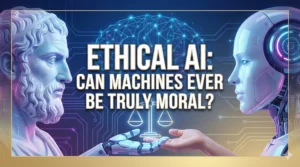
Understanding the future of machine ethics and human responsibility
Artificial Intelligence (AI) is no longer a distant concept. It now guides our smartphones, helps diagnose diseases, recommends what we watch, powers self-driving cars, and even writes and designs content. As AI becomes more powerful and independent, one question keeps getting bigger:
Can machines be truly moral?
Or are they only following the rules given by humans?
This article breaks down the complex topic of Ethical AI in simple, clear language.

Ethical AI refers to the idea that AI systems should behave responsibly, fairly, and safely. The concern is simple:
AI is increasingly making decisions that affect real people — hiring, loan approval, medical suggestions, security, and even life-and-death situations.
So, the key question is:
Can a machine understand right and wrong? Or can it only mimic ethical behavior without truly feeling it?
Let’s explore.
Ethics is a set of principles that helps humans decide what is right and wrong. It involves values like:
These values guide human behavior in complex situations.
Unlike humans, machines cannot feel emotions such as empathy, guilt, or compassion.
Human morality is shaped by:
Machines, on the other hand, follow logic, codes, and data. So even if we try to convert ethics into rules, machines still cannot “understand” morality — they can only follow instructions.
Older AI systems completely follow fixed rules.
Example:
A traffic camera that fines cars crossing a red light.
These systems are predictable, but they cannot learn or adapt.
Modern AI learns patterns from massive amounts of data.
It improves over time but cannot explain why it reached a decision.
Example:
An AI hiring tool that learns which resumes to reject or approve based on past data.
Many advanced AIs are “black boxes,” meaning even developers cannot fully explain how exactly the AI reached a particular decision. This creates risk — especially if the AI becomes biased.
If AI learns from biased or unfair data, the AI becomes biased too.
Examples include:
If AI becomes too independent, should humans still approve its decisions?
Example: A self-driving car deciding in milliseconds whom to avoid in an accident.
AI collects huge amounts of personal information.
Questions arise:
Some AIs make decisions that could affect human lives:
Should machines be allowed to make such decisions?
Machines cannot feel pain, empathy, regret, compassion, or guilt.
Morality often depends on emotions — AIs don’t have them.
Ethical decisions depend on:
Machines analyze patterns, not intentions.
Engineers can program ethical rules, but AI cannot develop a moral character.
Example:
A robot can be programmed not to hurt people, but it doesn’t understand why hurting is wrong.
To make AI moral, researchers try converting ethical theories into algorithms:
But no single philosophy works in all situations.
Modern AI design includes principles like:
These frameworks ensure AI behaves responsibly.
Most experts agree:
AI should not be fully autonomous. Humans must supervise major decisions.
If a self-driving car causes an accident, who is at fault?
Most laws say humans are responsible, not machines.
Because AI does not have intentions — only humans do.
These show why moral machines are a huge challenge.
Countries are creating AI laws:
These laws aim to make AI safer and more transparent.
Explainable AI (XAI) focuses on making decisions understandable.
Companies must prioritize:
AI could behave as if it is moral — by following ethical rules.
But true morality requires consciousness and emotion.
So the expected answer is:
Machines can act moral, but they cannot be moral.
As AI becomes more powerful, building ethical systems is not optional — it is necessary. Machines cannot feel moral responsibility, but humans can design them with safety, fairness, and transparency in mind.
Perhaps the real question isn’t whether machines can be moral.
The real question is: Can we humans build AI that reflects the best of our morality?
Because the future of Ethical AI depends more on us — and less on the machines we create.