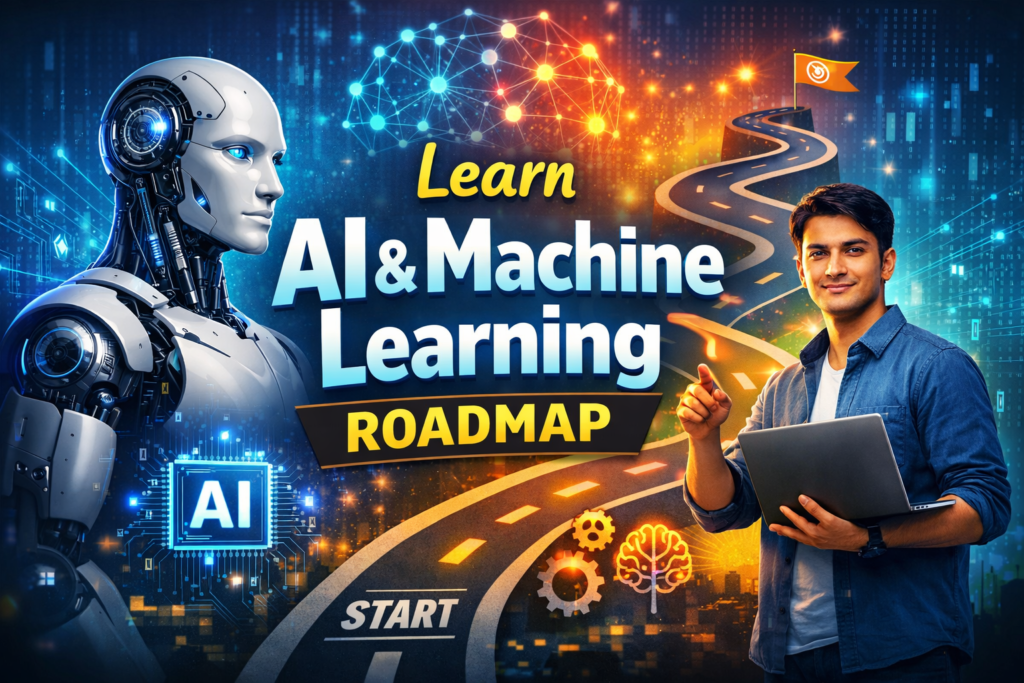
Learn AI & Machine Learning Roadmap (2026) – From Beginner to Expert

Learn AI & Machine Learning Roadmap (2026) – From Beginner to Expert

Phase 1: Understanding AI & the Learning Mindset

Learn AI & Machine Learning Roadmap (2026) – From Beginner to Expert

Before writing a single line of code, it’s critical to understand what AI actually is and what it is not.

Artificial Intelligence is about building systems that can simulate human-like decision making, not human intelligence itself. Machine Learning is a subset of AI that focuses on learning patterns from data instead of following hard-coded rules.

At this stage, learners should focus on:

  • The evolution of AI (rule-based systems → data-driven models)
  • Differences between AI, Machine Learning, and Deep Learning
  • Where AI succeeds and where it fails
  • Ethical concerns, bias, and limitations of intelligent systems
  • Developing a problem-solving mindset instead of memorizing tools

Outcome: You think like an AI practitioner, not just a coder.

Phase 2: Python Programming for AI

Python is the backbone of AI & ML due to its simplicity and ecosystem.

This phase is not about learning “Python syntax” only—it’s about learning how to think in code.

Key focus areas:

  • Writing logical programs using loops and conditions
  • Using functions to break problems into smaller parts
  • Understanding data structures and why they matter for performance
  • Object-Oriented Programming for scalable projects
  • Writing readable, reusable, and maintainable code
  • Using notebooks for experimentation and scripts for production

Outcome: You can translate real-world problems into Python programs.

Phase 3: Mathematics Behind Machine Learning

Machine Learning models are mathematical machines disguised as code.

Instead of memorizing formulas, learners must understand:

  • How vectors and matrices represent data
  • Why matrix multiplication powers neural networks
  • How probability helps models deal with uncertainty

  • Why gradients guide models toward better solutions
  • How optimization improves model accuracy

This phase builds intuition, not fear of math.

Outcome: You understand why models work, not just how to use them.

Phase 4: Data Understanding & Preparation

Data is the fuel of AI—and most real-world data is messy.

This phase focuses on:

  • Understanding structured and unstructured data
  • Identifying noisy, biased, or incomplete data
  • Cleaning, transforming, and standardizing datasets
  • Feature engineering: turning raw data into useful signals
  • Visualizing data to uncover patterns and insights

Outcome: You can prepare real-world data for intelligent systems.

Phase 5: Core Machine Learning Concepts

Before diving into algorithms, learners must grasp how machines learn.

Conceptual foundations include:

  • Learning from examples vs explicit programming
  • Supervised vs unsupervised learning
  • Training, validation, and testing cycles
  • Overfitting, underfitting, and generalization
  • Model performance vs real-world usefulness

Outcome: You understand the learning process, not just the models.

Phase 6: Supervised Machine Learning (Prediction Systems)

Supervised learning teaches machines using labeled data.

This phase dives into:

  • Linear and logistic regression for foundational intuition
  • Distance-based algorithms like KNN
  • Tree-based models for decision-making logic
  • Ensemble methods for performance improvement
  • Evaluation metrics beyond accuracy

Outcome: You can build systems that predict outcomes reliably.

Phase 7: Unsupervised Learning (Pattern Discovery)

Not all data comes with labels.

Here, learners explore:

  • Clustering for customer segmentation
  • Dimensionality reduction for simplification
  • Discovering hidden structures in complex datasets
  • Anomaly detection for fraud or system failures

Outcome: You can extract meaning from unlabeled data.

Phase 8: Model Improvement & Validation

A working model is rarely a good model.

This phase focuses on:

  • Improving generalization
  • Hyperparameter tuning
  • Cross-validation strategies
  • Feature selection and dimensional reduction
  • Handling class imbalance and data leakage

Outcome: You can refine models for real-world performance.

Phase 9: Deep Learning & Neural Networks

Deep Learning mimics the structure of the human brain at scale.

Key concepts include:

  • Artificial neurons and layered networks
  • Activation functions and loss optimization
  • Backpropagation and gradient descent
  • Frameworks like TensorFlow and PyTorch
  • When deep learning is appropriate—and when it’s not

Outcome: You understand modern AI systems at a conceptual and practical level.

Phase 10: Specialized AI Domains

After mastering fundamentals, learners choose a specialization.

Domains include:

  • NLP for text and language intelligence
  • Computer Vision for image and video understanding
  • Speech processing for voice-based systems
  • Recommendation systems for personalization
  • Generative AI for content creation
  • Reinforcement Learning for decision-making agents

Outcome: You build expertise in a focused AI domain.

Phase 11: Real-World Projects & Research Thinking

Projects transform knowledge into skill.

This phase emphasizes:

  • End-to-end AI pipelines
  • Working with real, imperfect datasets
  • Experiment tracking and documentation
  • Reproducing research ideas in simple form
  • Learning from failures and model limitations

Outcome: You gain real-world confidence, not just certificates.

Phase 12: Deployment, Ethics & MLOps Basics

AI is incomplete until it reaches users.

Learners should understand:

  • Model deployment concepts
  • Monitoring performance over time
  • Data drift and model decay
  • Ethical AI, fairness, and transparency
  • Responsible AI design principles

Outcome: You build AI that is usable, scalable, and responsible.

Learn AI & Machine Learning Roadmap (2026) – From Beginner to Expert

Phase 13: Career Growth & Lifelong Learning

AI is an evolving field.

This final phase focuses on:

  • Building a strong portfolio and GitHub presence
  • Understanding industry expectations
  • Interview preparation for ML roles
  • Reading research papers effectively
  • Staying updated with AI advancements

Outcome: You grow continuously as an AI professional.

Leave a Reply

Your email address will not be published. Required fields are marked *

🎧 ARTICLE READER
🔊