Physical Address
Mumbai, Maharashtra - 400037

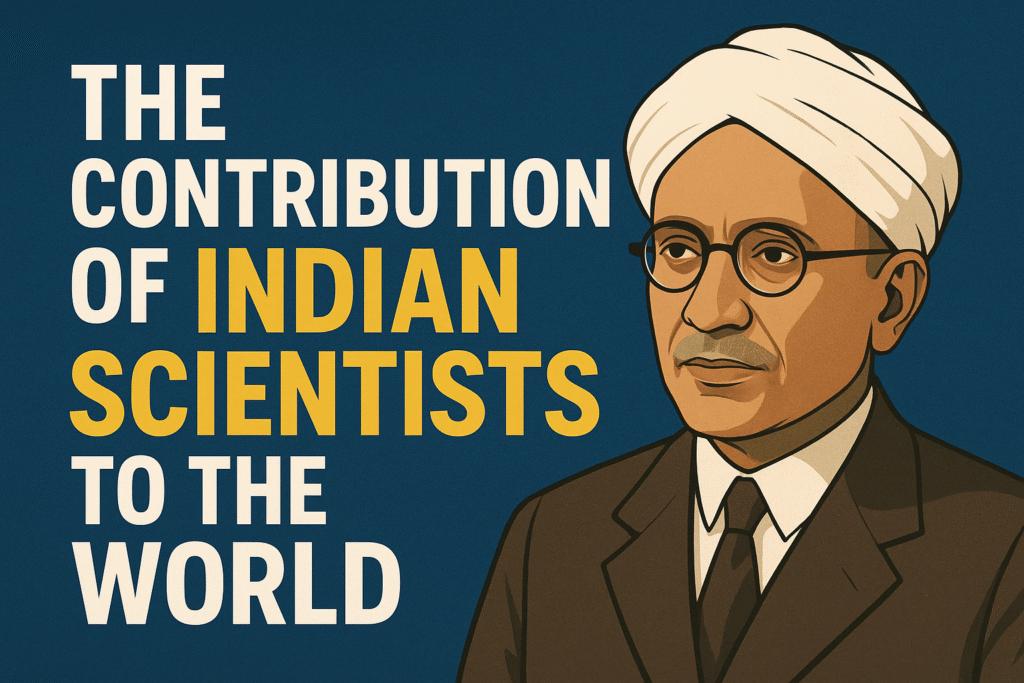
India has long been a land of knowledge, innovation, and scientific curiosity. From ancient discoveries in mathematics and astronomy to modern breakthroughs in space technology and medicine, Indian scientists have left an indelible mark on the global scientific community. Their contributions span centuries and continue to inspire new generations to explore, innovate, and redefine what’s possible.
India’s scientific legacy began thousands of years ago, when scholars and thinkers were already developing concepts that would shape modern science.
These thinkers not only advanced science but also infused it with philosophy, ethics, and holistic understanding—values that continue to influence research today.
With the advent of modern education and research institutions, India witnessed a surge of scientific talent that shaped multiple global industries.
In 1930, Sir Chandrasekhara Venkata Raman became the first Asian to receive a Nobel Prize in Physics for discovering the Raman Effect, which explains how light scatters when it passes through a transparent material. This discovery revolutionized spectroscopy and continues to impact chemistry, physics, and material science.
Dr. Homi Jehangir Bhabha laid the foundation of India’s nuclear energy program and established premier institutions like TIFR (Tata Institute of Fundamental Research) and BARC (Bhabha Atomic Research Centre), placing India among the world’s leaders in nuclear research.
Known for his pivotal role in developing India’s missile and space programs, Dr. Kalam was instrumental in the creation of the Agni and Prithvi missiles. His vision for technology-led development made science accessible and aspirational for millions of young Indians.
Collaborating with Albert Einstein, S.N. Bose laid the groundwork for quantum statistics, leading to the discovery of Bose-Einstein Condensate—a new state of matter. The subatomic particle boson was named in his honor, marking his permanent place in quantum physics.
Founder of ISRO (Indian Space Research Organisation), Dr. Vikram Sarabhai envisioned harnessing space technology for societal development. His leadership led to the creation of India’s first satellites, paving the way for the country’s current success in space exploration.
Today, India continues to make waves in diverse scientific fields:
The success of Indian scientists demonstrates the nation’s ability to blend tradition with innovation. From the timeless works of Aryabhata to the modern triumphs of ISRO, India’s scientific journey is one of resilience, creativity, and vision.
As India moves toward becoming a global leader in research and innovation, the next generation of scientists is poised to explore new frontiers—in space, health, technology, and beyond.
The contributions of Indian scientists have shaped not only India’s progress but also the world’s understanding of science and technology. Their relentless pursuit of knowledge, combined with a spirit of service to humanity, continues to inspire future innovators to push the boundaries of possibility.
(adsbygoogle = window.adsbygoogle || []).push({});