From Zero Skills to Freelance Income: Complete Action Plan
BIG PICTURE STRUCTURE
This roadmap is not about learning randomly. It is a progressive execution system where each phase builds on the previous one.
| Phase | Focus | Output |
| Phase 1 | Foundation + Execution | Content creation habit + clarity |
| Phase 2 | Skill Development | Marketable freelance skills |
| Phase 3 | Monetization | First client and income proof |
| Phase 4 | Scaling | Stable monthly income system |
| Phase 5 | Authority | Personal brand and high-income positioning |
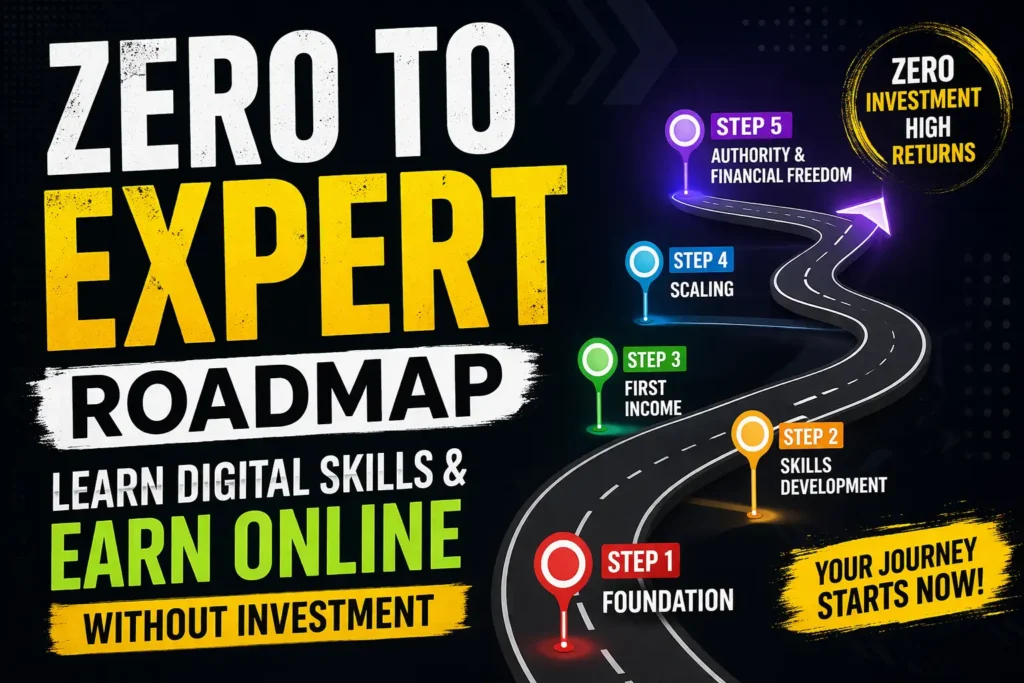 Zero to Expert Roadmap
PHASE 1: FOUNDATION (DAY 1–15)
Objective
The primary objective of Phase 1 is to break passive consumption habits and transition into active creation and execution.
Most beginners fail here because they:
- Watch tutorials but never apply
- Overthink niche selection
- Wait for perfection before starting
This phase eliminates those mistakes.
Core Principle
You are not here to learn first and act later.
You are here to:
- Learn a little
- Apply immediately
- Improve through repetition
If you are not creating content daily, you are not progressing.
What You Need to Learn
1. Social Media Fundamentals
Understand how platforms function at a basic level:
- Instagram: discovery via Reels and engagement
- LinkedIn: authority and professional positioning
- Facebook: communities and reach via groups
You do not need advanced knowledge here. Focus on:
- How content is consumed
- What type of content performs
- Basic platform behavior
2. Content Types (Critical Understanding)
You need to understand three primary content formats:
Reels (Short-form Video)
Purpose:
- Reach new audience
- Increase visibility
Characteristics:
- Fast-paced
- Hook in first 2 seconds
- Simple, clear message
Carousel Posts
Purpose:
- Provide value
- Increase saves and shares
Structure:
- Hook (first slide)
- Problem explanation
- Solution breakdown
- Actionable takeaway
Static Posts
Purpose:
- Branding and consistency
- Visual identity
3. Canva Basics
You do not need advanced design skills. Focus on:
- Template usage
- Font pairing (2–3 fonts max)
- Color consistency (2–4 colors)
- Alignment and spacing
- Visual hierarchy
Avoid:
- Overdesigning
- Using too many colors or fonts
- Copying without understanding
Execution Plan (Non-Negotiable)
You must create your own content platform.
Step 1: Create a Niche Page
Example:
- Name: Digital Growth with Suraj
- Niche Options:
- Digital marketing
- Freelancing
- AI tools
- Content creation
Do not overthink niche selection. Choose one and start.
Daily Action System
This is mandatory. No negotiation.
Daily Tasks:
- One carousel post
- One reel
- 10–15 minutes of commenting on similar creators
Why This System Works
- Posting builds skill
- Repetition builds clarity
- Feedback builds improvement
- Visibility builds opportunity
Content Creation Framework
Use this simple formula:
Hook → Value → Action
Example:
Hook:
“If your posts are getting zero views, you are making this mistake”
Value:
Explain the mistake and solution
Action:
“Save this post and apply today”
Commenting Strategy
Do not scroll passively.
Instead:
- Comment on creators in your niche
- Add value in comments
- Stay consistent
This builds:
- Visibility
- Network
- Early audience
Common Mistakes in Phase 1
Avoid these strictly:
- Watching more than creating
- Comparing with advanced creators
- Changing niche frequently
- Skipping days
Time Investment Structure (Daily 3–4 Hours)
| Task | Time |
| Learning basics | 45–60 minutes |
| Canva/design practice | 60 minutes |
| Content creation | 60–90 minutes |
| Engagement (comments) | 15–20 minutes |
Expected Outcome After 15 Days
By the end of Phase 1, you should have:
- 20–30 posts published
- Basic Canva understanding
- Improved content clarity
- Reduced hesitation in posting
You will not be perfect, but you will be functional.
That is the goal.
Reality Check
You may feel:
- Your content is not good enough
- You are not getting views
- Others are doing better
This is normal.
At this stage:
- Quantity matters more than quality
- Execution matters more than perfection
Transition to Phase 2
You move to Phase 2 only when:
- You are consistently posting
- You understand basic content structure
- You are comfortable using Canva
If not, extend Phase 1 by 5–7 days.
PHASE 2: SKILL DEVELOPMENT (DAY 16–45)
Objective
The goal of this phase is simple:
Move from content creator → service provider
You are no longer just posting for yourself.
You are preparing to solve problems for clients.
Core Principle
You do not need to be perfect.
You need to be:
- Reliable
- Consistent
- Problem-solving oriented
Clients do not pay for perfection.
They pay for results and clarity.
Skills You Must Develop
This phase is built around three high-demand skills:
- Social Media Management
- Copywriting
- Ads Basics
These skills are interconnected and form a strong freelance foundation.
SKILL 1: SOCIAL MEDIA MANAGEMENT
What This Means
Managing a brand’s social media presence in a structured, growth-focused way.
Key Components
1. Content Planning
You must learn how to plan content weekly.
Example Weekly Structure:
| Day | Content Type |
| Monday | Educational carousel |
| Tuesday | Reel (tip-based) |
| Wednesday | Case study or story |
| Thursday | Reel (trend-based) |
| Friday | Carousel (actionable tips) |
| Saturday | Personal or relatable content |
| Sunday | Engagement or Q&A |
2. Caption Writing Structure
Every caption should follow:
Hook → Value → Call to Action
Example:
Hook:
“Most Instagram pages fail because of this one mistake”
Value:
Explain mistake + give solution
CTA:
“Save this and follow for more”
3. Hashtag Strategy (Basic but Important)
Do not spam random hashtags.
Use:
- 3–5 niche hashtags
- 3–5 medium competition hashtags
- 2–3 broader hashtags
Example:
#digitalmarketingtips
#contentstrategy
#socialmediamarketing
4. Basic Analytics Understanding
You must understand:
- Reach (how many people saw your content)
- Engagement (likes, comments, shares)
- Saves and shares (most important signals)
What Clients Expect from a Social Media Manager
- Consistent posting
- Better content structure
- Growth in engagement
- Clear communication
Not viral content every day.
SKILL 2: COPYWRITING (HIGH-INCOME SKILL)
Why This Matters
Design attracts attention.
Copy converts attention into action.
Without good copy:
- Your posts will not perform
- Your ads will fail
- Your services will not sell
Core Framework
Problem → Solution → Action
Writing Hooks (Critical Skill)
The first line decides everything.
Weak Hook:
“Social media tips for beginners”
Strong Hook:
“If your posts are not getting views, you are making this mistake”
Types of Hooks You Should Practice
- Problem-based
- Curiosity-based
- Result-based
- Mistake-based
Practice System for Copywriting
Daily practice:
- Rewrite 3 captions from top creators
- Improve hooks
- Simplify language
- Make it more engaging
Caption Improvement Example
Before:
“Post consistently to grow your account”
After:
“If you are posting daily but still not growing, this is why”
Common Copywriting Mistakes
- Writing long, boring sentences
- No clear structure
- Weak or no call-to-action
- Trying to sound “professional” instead of clear
SKILL 3: ADS BASICS (BEGINNER LEVEL)
You are not becoming an expert yet.
You are building foundational understanding.
Platforms to Learn
- Meta Ads (Facebook + Instagram)
- Google Ads (basic awareness)
What You Must Understand
1. Campaign Objectives
Why are you running ads?
- Awareness
- Traffic
- Leads
- Sales
2. Audience Targeting
Basic targeting concepts:
Example:
Target people interested in:
- Digital marketing
- Freelancing
- Online business
3. Budget Basics
You do not need large budgets.
Understand:
- Daily budget vs total budget
- Testing small before scaling
Important Note
At this stage:
- Focus on understanding, not mastery
- Learn how ads work, not advanced optimization
PRACTICE SYSTEM (MOST IMPORTANT PART)
Learning without practice is useless.
Weekly Practice Plan
Minimum Requirement:
- 5 posts per week
- 3 reels per week
- Daily copywriting practice
Study System
Every day:
- Analyze 3 successful creators
- Observe:
- Hooks
- Content style
- Structure
Do not copy blindly.
Understand why it works.
Skill Integration (Critical Step)
Combine all skills:
- Design (Canva)
- Copy (writing)
- Strategy (content planning)
This combination makes you valuable.
BUILDING YOUR PORTFOLIO
Before getting clients, you need proof.
What to Include
- Your own page content
- Before/after improvements
- Sample posts
- Caption examples
Simple Portfolio Format
You can use:
- Google Drive folder
- Notion page
- Basic PDF
Keep it simple and clear.
CLIENT-READY CHECKLIST
Before moving to Phase 3, ensure:
- You can create content consistently
- You understand basic analytics
- You can write engaging captions
- You have at least 20–30 quality posts
- You have a basic portfolio
If these are not ready, do not rush.
TIME STRUCTURE (DAILY 4–5 HOURS)
| Task | Time |
| Learning | 60 minutes |
| Content creation | 90–120 minutes |
| Copywriting practice | 45 minutes |
| Study creators | 30 minutes |
| Engagement | 20–30 minutes |
EXPECTED OUTCOME (DAY 45)
By the end of this phase, you should be:
- Confident in content creation
- Able to write strong captions
- Understanding how social media works
- Ready to offer services
You are not an expert yet.
But you are now:
Capable and ready for real-world execution.
REALITY CHECK
At this stage:
- Growth may still be slow
- Income may still be zero
This is normal.
You are building:
- Skills
- Systems
- Confidence
Money comes in the next phase.
TRANSITION TO PHASE 3
Move to Phase 3 only when:
- You can create content without confusion
- You understand basic strategy
- You have proof of work
PHASE 3: MONETIZATION (DAY 45–75)
Objective
The goal of this phase is:
Get your first paying client and generate proof of income
This phase is not about scaling or earning high income yet.
It is about:
- Validating your skills in the market
- Building confidence through real work
- Creating proof that you can deliver results
Core Principle
Do not chase high income in the beginning.
Focus on:
- Experience
- Execution
- Results
Your first ₹1000 is more valuable than theoretical knowledge.
STEP 1: CREATE SIMPLE, CLEAR OFFERS
Most beginners fail because they:
- Complicate their services
- Try to offer everything
- Do not communicate clearly
You need simple, outcome-based offers.
Offer Structure
Your offer should answer:
What will you do?
How will it help the client?
Beginner-Friendly Offers
Start with these:
- Instagram Page Management
“I will manage your Instagram page and post content consistently”
- Content Creation
“I will design 30 posts for your brand using Canva”
- Organic Growth Support
“I will help improve your page growth with better content strategy”
Important Rule
Do not promise unrealistic results like:
- Guaranteed followers
- Viral content
Focus on:
- Consistency
- Improvement
- Strategy
STEP 2: CLIENT HUNTING SYSTEM
This is where most people fail.
They learn skills but avoid outreach.
No outreach = No clients
Where to Find Clients
1. Instagram (Primary Platform)
Search for:
- Small business pages
- Personal brands
- Coaches and creators
Look for pages with:
- Poor design
- Inconsistent posting
- Low engagement
These are opportunities.
2. LinkedIn
- Connect with business owners
- Engage with their posts
- Send simple messages
3. WhatsApp Groups
- Local business groups
- Freelancing communities
4. Local Businesses (Highly Underrated)
Examples:
- Cafes
- Gyms
- Salons
- Clothing stores
Most of them need social media help but lack knowledge.
STEP 3: OUTREACH SYSTEM
Keep it simple, direct, and helpful.
Basic Outreach Message
“Hi, I checked your page. It has good potential, but your content strategy can be improved.
I can help you with better design and consistent posting to improve engagement.
Let me know if you would like a sample.”
Why This Works
- Personal (you checked their page)
- Problem-focused
- Solution-oriented
- Low pressure
Outreach Rules
- Send 20–30 messages daily
- Do not copy-paste blindly
- Personalize slightly
- Stay consistent
Follow-Up System
If no reply:
Day 2–3:
“Just checking if you saw my message”
Keep it polite and short.
STEP 4: SAMPLE WORK (VERY IMPORTANT)
Before clients pay, they need trust.
What You Can Do
- Redesign 2–3 of their posts
- Write improved captions
- Suggest content ideas
Purpose
Show:
- Your thinking
- Your skill
- Your value
This increases conversion chances significantly.
STEP 5: PRICING STRATEGY (BEGINNER LEVEL)
Do not overprice.
Do not underprice too much either.
Recommended Pricing
| Service | Price Range |
| 10–15 posts/month | ₹500 – ₹1500 |
| Full page management | ₹1000 – ₹3000 |
Important Note
Your first goal is not profit.
Your goal is:
- Experience
- Testimonials
- Proof
STEP 6: CLOSING THE CLIENT
When a client shows interest:
What to Do
- Understand their needs
- Explain your approach simply
- Show sample work
- Offer a clear package
Example Response
“I will create and post content regularly, improve your page design, and help increase engagement.
We can start with 15 posts for ₹1000 this month.”
Keep It Simple
Do not confuse clients with:
- Technical jargon
- Complex strategies
Clarity builds trust.
STEP 7: DELIVERING RESULTS
Once you get a client:
Execution becomes everything.
What You Must Do
- Deliver on time
- Maintain quality
- Communicate regularly
Weekly Workflow Example
- Plan content
- Design posts
- Write captions
- Schedule or send for approval
Communication Rule
Update client regularly.
Example:
“Your content for this week is ready. Let me know if any changes are needed.”
STEP 8: GET TESTIMONIALS
After delivering work:
Ask for feedback.
Simple Message
“Did you like the work? If yes, can you share a short testimonial?”
Why This Matters
Testimonials help you:
- Build trust
- Get future clients faster
- Increase pricing later
EXPECTED RESULTS (DAY 75)
If executed properly:
- First client acquired
- First income earned (₹500–₹3000)
- Real experience gained
- Confidence improved
COMMON MISTAKES (STRICTLY AVOID)
- Waiting for perfection before outreach
- Sending very few messages
- Giving up after rejection
- Overthinking pricing
- Not following up
DAILY EXECUTION SYSTEM (4–5 HOURS)
| Task | Time |
| Content creation | 1–1.5 hours |
| Skill improvement | 1 hour |
| Outreach | 1–1.5 hours |
| Sample work | 30–45 minutes |
| Learning/analysis | 30 minutes |
REALITY CHECK
You will face:
- Rejections
- No replies
- Low initial earnings
This is part of the process.
Success in this phase depends on:
- Consistency in outreach
- Willingness to improve
- Execution discipline
TRANSITION TO NEXT PHASE
Move forward only when:
- You have at least 1–2 clients
- You have proof of work
- You understand client handling
FINAL TRUTH OF PHASE 3
Skills alone do not make money.
Action does.
PHASE 4: SCALING (MONTH 2–4)
Objective
The goal of this phase is:
Build a predictable, repeatable income system
You are no longer focused on:
- Learning basics
- Finding first client
You are now focused on:
- Increasing income
- Improving efficiency
- Creating systems
Core Principle
You do not scale by working more hours.
You scale by:
- Increasing value
- Improving pricing
- Creating structured workflows
STEP 1: INCREASE YOUR VALUE (NOT JUST WORK)
At beginner level, you were doing:
- Posting content
- Basic design
Now you must evolve into someone who provides results and strategy.
Upgrade Your Services
From Basic → Advanced
| Beginner Service | Scaled Version |
| Posting content | Full content strategy |
| Designing posts | Brand-focused content system |
| Writing captions | Conversion-focused copy |
| Random posting | Planned growth system |
New Services You Must Add
1. Content Strategy
Instead of just posting, you now:
- Plan monthly content
- Align posts with goals
- Structure growth
2. Social Media Growth System
Help clients with:
- Consistency plan
- Engagement improvement
- Content direction
3. Meta Ads Management (Basic to Intermediate)
Start offering:
- Ad setup
- Audience targeting
- Basic performance monitoring
4. Lead Generation Support
Help clients get:
STEP 2: PRICING UPGRADE
You cannot reach ₹50K/month with ₹1000 clients.
You must increase pricing strategically.
New Pricing Structure
| Level | Price per Client |
| Beginner | ₹1K – ₹3K |
| Intermediate | ₹5K – ₹10K |
| Advanced | ₹10K – ₹15K |
Target Calculation
To reach ₹30K–₹50K/month:
Option 1:
Option 2:
Option 3:
Important Rule
Do not jump pricing suddenly.
Increase when:
- You deliver consistent results
- You have testimonials
- You have confidence
STEP 3: CLIENT MANAGEMENT SYSTEM
At this stage, chaos will reduce your growth.
You need structure.
Weekly Workflow System
Step 1: Planning
- Plan content for the week
- Get client approval
Step 2: Creation
- Design posts
- Write captions
Step 3: Scheduling
- Schedule posts or send to client
Step 4: Analysis
- Check performance
- Improve next week
Tools You Can Use
- Canva (design)
- Google Sheets (planning)
- Meta Business Suite (scheduling)
Keep it simple. Do not overcomplicate tools.
STEP 4: IMPROVE CLIENT COMMUNICATION
Better communication = Higher retention
What You Should Do
- Weekly updates
- Clear reporting
- Simple explanations
Example Update
“This week your engagement improved by 20%. Reels are performing better than posts. Next week we will focus more on reels.”
Why This Matters
Clients stay when they:
- Understand progress
- See effort
- Trust your process
STEP 5: BUILD SYSTEMS (KEY TO SCALING)
Without systems, you will burn out.
System 1: Content Templates
- Create reusable Canva templates
- Reduce design time
- Maintain consistency
System 2: Caption Frameworks
Create reusable structures:
- Hook bank
- CTA list
- Content formats
System 3: Workflow Checklist
For every client:
- Content plan ready
- Designs completed
- Captions written
- Scheduled
STEP 6: IMPROVE SKILLS DEEPLY
Now you move from basic understanding → deeper expertise.
Focus Areas
1. Analytics
Understand:
- What type of content works
- Why it works
- How to improve
2. Content Psychology
Learn:
- Why people engage
- What makes content shareable
- Emotional triggers
3. Funnel Basics
Understand simple flow:
Content → Interest → Message → Conversion
STEP 7: GET MORE CLIENTS (SMART WAY)
Do not stop outreach.
But now improve your approach.
Advanced Outreach Strategy
Instead of generic messages:
- Show insights
- Give suggestions
- Demonstrate expertise
Example
“I noticed your reels are getting reach, but your profile is not converting visitors into followers. A better content structure can fix this.”
This shows:
- Observation
- Understanding
- Value
STEP 8: RETENTION STRATEGY
Getting clients is hard.
Keeping them is easier and more profitable.
How to Retain Clients
- Deliver consistently
- Show progress
- Communicate clearly
- Suggest improvements
Monthly Review System
Every month:
- Share performance summary
- Suggest next plan
DAILY WORK STRUCTURE (5–6 HOURS)
| Task | Time |
| Client work | 2–3 hours |
| Content creation (your page) | 1 hour |
| Learning/upgrading skills | 1 hour |
| Outreach/networking | 30–60 minutes |
EXPECTED OUTCOME (MONTH 4)
If executed properly:
- 3–5 active clients
- Monthly income ₹30K–₹50K
- Strong confidence
- Structured workflow
COMMON SCALING MISTAKES
Avoid these strictly:
- Taking too many low-paying clients
- Not increasing pricing
- Poor time management
- No system or workflow
- Ignoring skill improvement
REALITY CHECK
Scaling is not easy.
You will face:
- Time pressure
- Client demands
- Mistakes in delivery
But this phase defines your growth.
TRANSITION TO FINAL PHASE
Move to Phase 5 when:
- Income is stable
- You have repeat clients
- You have confidence in your skills
FINAL TRUTH OF PHASE 4
You do not earn more by doing more work.
You earn more by becoming more valuable.
PHASE 5: AUTHORITY BUILDING & LONG-TERM INCOME SYSTEM (MONTH 4–6+)
Objective
The goal of this phase is:
Build a personal brand and create multiple income streams
At this stage:
- You already have skills
- You already have clients
- You already have income
Now the focus shifts to:
- Visibility
- Positioning
- Leverage
Core Principle
Freelancing gives income.
Authority gives scale.
If you only rely on clients:
- Your time is limited
- Your income is capped
If you build authority:
- Opportunities increase
- Income multiplies
- Dependence on clients reduces
STEP 1: BUILD YOUR PERSONAL BRAND
What is Personal Branding
It is how people perceive you in your niche.
You are no longer just:
A freelancer
You are now:
- A problem solver
- A knowledge source
- A trusted expert
Platform Strategy
Focus on 2–3 platforms:
1. Instagram
- Short-form content
- Daily visibility
2. LinkedIn
- Authority positioning
- Professional audience
3. YouTube (Optional but powerful)
- Long-form content
- Deep trust building
Content Strategy for Authority
Shift from:
“Basic tips”
To:
“Insights + experience + results”
Content Types You Must Create
1. Educational Content
Teach clearly and simply.
Example:
- Content strategy breakdown
- Mistakes beginners make
2. Case Studies
Show real work:
- Before vs after
- Client results
- Growth analysis
3. Personal Experience
Share:
- What worked
- What failed
- Lessons learned
4. Opinion Content
Position yourself:
- What you believe
- What is wrong in the industry
Content Frequency
Minimum:
- 1 post daily (Instagram)
- 3–4 posts weekly (LinkedIn)
Consistency builds authority.
STEP 2: BUILD DIGITAL ASSETS
Authority is not only content.
You must build assets you own.
1. Website or Blog
Purpose:
- Long-term authority
- SEO traffic
- Professional credibility
You can create:
- Blog posts
- Service pages
- Case studies
2. Email List
This is one of the most powerful assets.
Why:
- You own the audience
- No algorithm dependency
How to Start
Offer something free:
- Checklist
- Guide
- Templates
In exchange for email.
3. Content Library
Organize your:
- Best posts
- Templates
- Frameworks
This becomes:
Future product material
STEP 3: MULTIPLE INCOME STREAMS
Now you move beyond client work.
1. Freelancing (Base Income)
Continue with:
- High-paying clients
- Retainers
2. Affiliate Marketing
Strategy
Teach → Recommend → Earn
What to Promote
- Design tools
- Hosting platforms
- Marketing tools
- AI tools
Example Flow
- Create content about Canva
- Share your experience
- Add affiliate link
3. Digital Products
High-margin income.
What You Can Sell
- Canva templates
- Content calendars
- Caption swipe files
- Courses
Why This Works
You create once
You sell multiple times
4. Consulting
Charge for your expertise.
Example Services
- 1:1 consultation
- Strategy calls
- Account audits
Pricing Potential
₹1000 → ₹5000 per session (or more as authority grows)
STEP 4: POSITIONING YOURSELF AS AN EXPERT
You must shift perception.
From This:
“I manage social media”
To This:
“I help businesses grow using content strategy and marketing systems”
How to Position Yourself
- Speak with clarity
- Show results
- Share insights
- Be consistent
STEP 5: BUILD TRUST AT SCALE
Trust is your biggest asset.
How to Build Trust
- Show real results
- Share honest experiences
- Avoid fake claims
- Be consistent
Proof Types
- Testimonials
- Screenshots
- Case studies
STEP 6: CREATE SYSTEMS FOR PASSIVE INCOME
Passive income does not mean zero work.
It means:
- Front-loaded effort
- Long-term returns
Example System
Step 1:
Create valuable content
Step 2:
Offer free resource
Step 3:
Collect emails
Step 4:
Promote product or service
Funnel Example
Content → Free Value → Trust → Offer → Income
STEP 7: SCALE YOUR TIME (IMPORTANT)
You cannot grow if you do everything manually.
Options to Scale
1. Delegate Work
- Hire designers
- Hire editors
2. Use Templates
3. Productize Services
Instead of custom work:
- Fixed packages
- Clear deliverables
STEP 8: LONG-TERM STRATEGY
Think beyond months.
6–12 Month Vision
- Strong personal brand
- Multiple income streams
- Stable monthly income
- Authority in niche
Growth Path
Freelancer → Specialist → Authority → Educator → Brand
DAILY STRUCTURE (5–6 HOURS)
| Task | Time |
| Client work | 2–3 hours |
| Content creation | 1–1.5 hours |
| Learning/improvement | 30–60 minutes |
| Product/asset building | 1 hour |
EXPECTED OUTCOME
If executed properly:
- ₹50K–₹1L+ monthly potential
- Multiple income streams
- Strong personal brand
- Reduced dependency on clients
COMMON MISTAKES (AVOID)
- Ignoring personal branding
- Only focusing on client work
- Not building assets
- Inconsistency in content
- Trying to scale too fast
FINAL TRUTH OF PHASE 5
Skills make you money.
Authority multiplies it.
You started from:
- Zero knowledge
- Zero investment
You built:
- Skills
- Clients
- Income
- Systems
- Authority
FINAL STRATEGY (OPTIMIZED PATH)
- Content Creation (Canva + Posting)
- Social Media Management
- Copywriting + Ads
- Freelancing Income
- Authority + Digital Products
FINAL REALITY
- First income is slow
- Growth is gradual
- Consistency is everything
This completes your full roadmap (Zero → Expert → Income → Authority).
Reader: 40