AI in Healthcare 2050 Predicting Diseases Before They Happen

AI in Healthcare 2050: Predicting Diseases Before They Happen

How continuous monitoring, multi-omics, digital twins, and privacy-first AI will turn reactive care into anticipatory medicine.

1. A Morning in 2050

It’s 7:10 AM in New Delhi, the year is 2050. Aarav, a 42-year-old software engineer, is getting ready for work when his smart health patch vibrates gently on his arm.
A notification appears on his wall-mounted health dashboard:

“Your cardiac digital twin predicts a 68% chance of micro-arterial stress within 48 hours. Please hydrate, skip caffeine today, and start the recommended anti-inflammatory protocol.”

Aarav isn’t sick. He feels perfectly fine.
Yet, his AI-driven health ecosystem has detected microscopic physiological trends—subtle changes in blood biomarkers, heart variability patterns, sleep rhythms, and environmental exposures—that even the most skilled doctor would never catch in time.

This is not science fiction anymore.
This is the future of healthcare in 2050: not curing diseases after they appear, but predicting and preventing them before they begin.

Thesis:
By 2050, AI won’t just assist doctors — it will forecast illness windows and enable preemptive interventions that could save millions of lives.
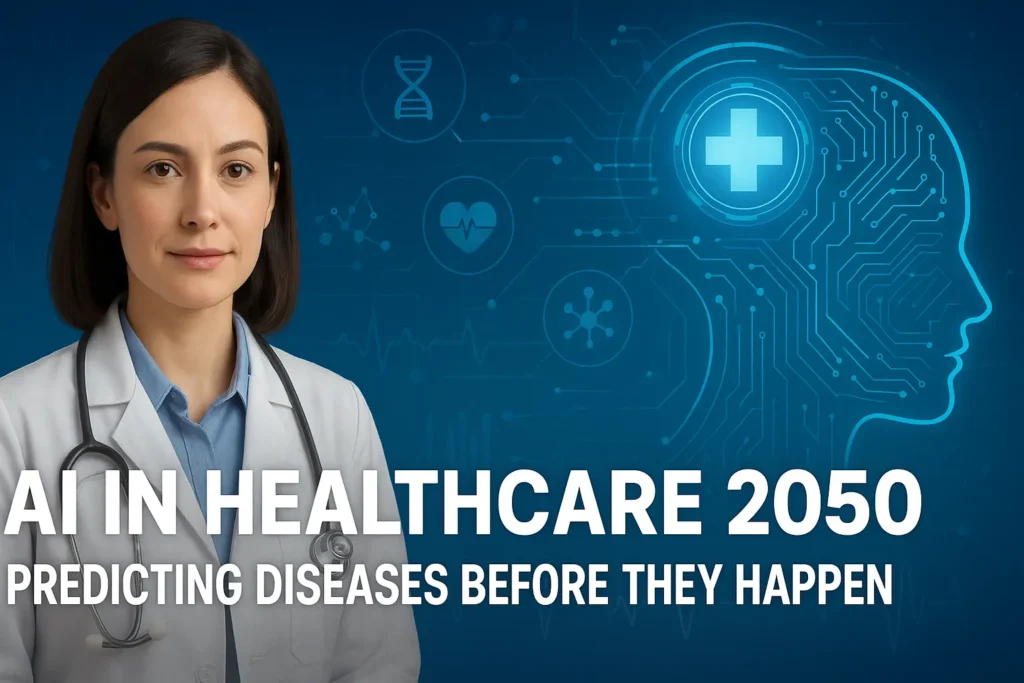
AI in Healthcare 2050 Predicting Diseases Before They Happen

2. Why Disease Prediction Matters

Today’s healthcare system is mostly reactive.
We wait for symptoms, rush to hospitals, undergo costly procedures, and hope for recovery. This delay leads to:

  • Late diagnoses, especially for cancer and heart disease
  • Preventable hospitalizations
  • High treatment costs
  • Chronic disease progression
  • Reduced lifespan and quality of life

But prediction changes everything.

Benefits of early disease prediction:

  • Fewer emergency admissions
  • Lower long-term healthcare costs
  • Personalized preventive plans
  • Better public health planning
  • Longer, healthier lives

Predictive healthcare takes us from “What is wrong?” to “What may go wrong—and how do we stop it?”

3. The Technological Stack Powering Disease Prediction in 2050

The future of predictive medicine rests on several powerful, interconnected technologies.

a. Continuous, Ambient Sensing

In 2050, health data flows from:

  • Smart wearables
  • Skin patches & implantable nano-sensors
  • Smart home air-quality & microbial sensors
  • Toilets that analyze biomarkers
  • Contact lenses that track glucose, pressure & hydration levels

Every heartbeat, breath, movement, and chemical signal becomes a data point.

Example:
Your living room air sensor detects increased pollutants → wearable notices slight inflammation → AI predicts future respiratory stress → your environment adjusts automatically.

b. Multi-Omics + Lifelong Health Records

Your health story isn’t just physical—it’s biological at multiple layers:

  • Genomics (your DNA blueprint)
  • Proteomics (your protein activity)
  • Metabolomics (chemical reactions in your body)
  • Microbiome (gut flora dynamics)

Combine this with a complete longitudinal electronic health record, and AI can see patterns across years—not just weeks.

c. Digital Twins & Physiological Simulators

A digital twin is a real-time computer model of your:

  • Heart
  • Lungs
  • Brain
  • Entire body

It’s like having a virtual version of yourself running simulations:

  • “What happens if you gain 5kg?”
  • “How will your heart respond to stress?”
  • “What if you don’t treat this early inflammation?”

Doctors of 2050 treat the twin before the actual patient.

d. Federated & Privacy-Preserving AI

Your data stays with you.

AI models learn collaboratively across hospitals without sharing raw patient data, thanks to:

  • Federated learning
  • Differential privacy
  • Homomorphic encryption

This preserves confidentiality while enabling countries to build global disease-prediction systems.

e. Real-Time Causal AI

Unlike traditional AI, which spots correlations, causal AI answers:

  • Why is this happening?
  • What is the root cause?
  • What happens if we intervene?

This makes AI explainable, trustworthy, and clinically reliable.

f. Edge Computing + 6G/Quantum Speed

By 2050:

  • Data processing happens on your device → no delay
  • 6G provides near-instant data transmission
  • Quantum computers solve complex biological predictions in seconds

Meaning predictions happen before the danger grows.

4. Real-World Use-Cases: What AI Will Predict

1. Cardiovascular Events

AI will predict:

  • Stroke risk
  • Arrhythmias
  • Micro-arterial blockages
  • Heart failure flare-ups

Days or even weeks before symptoms.

2. Neurodegenerative Diseases (Alzheimer’s, Parkinson’s)

Subtle changes in:

  • Gait
  • Speech
  • Sleep
  • Eye movement
  • Brain-wave patterns

will help detect diseases 10–15 years before onset.

3. Infectious Disease Outbreaks

Using:

  • Wastewater analysis
  • Wearable temperature patterns
  • Social mobility data
  • Satellite environmental insights

AI can predict outbreaks before the first hospital case.

4. Cancer Signals

Ultra-sensitive analysis of:

  • Circulating tumor DNA
  • Micro-vascular changes
  • Metabolomic shifts

will catch cancer in stage 0 or stage 1 — virtually eliminating late-stage diagnoses.

5. Mental Health Relapse

AI will recognize early signs of:

  • Depression
  • Anxiety
  • Burnout
  • Bipolar episodes

by analyzing sleep, energy levels, typing behavior, and social interaction.

Mini Case: How Maya Avoided a Stroke in 2048

Maya’s digital twin detected unusual blood flow turbulence.
Her wearable confirmed inflammation biomarkers.
AI predicted a 72% chance of minor stroke within 3 days.
Doctors intervened early with medication + rest.

Result: A stroke that never happened.

5. The Patient Journey in a Predictive-Care World

  1. Sensing: 24/7 data from sensors and environment
  2. Prediction: AI analyzes patterns
  3. Notification: Patient receives a risk alert
  4. Verification: Confirmatory tests (virtual & physical)
  5. Action: Personalized preventive plan
  6. Tracking: Continuous monitoring updates progress

“AI proposes. Clinicians validate. Patients choose.”

Control remains with the human — always.

6. Implementation Roadmap: 2025 → 2050

2025–2035: Foundation

  • Interoperable electronic health records
  • National AI testbeds
  • Early digital biomarkers
  • Small-scale federated learning pilots

2035–2042: Scaling Up

  • Strict global AI health regulations
  • Insurance coverage for preventive AI plans
  • Mature digital twins for major diseases

2042–2050: Full Predictive Healthcare

  • Population-wide disease dashboards
  • Real-time outbreak prevention
  • Preventive-first hospitals
  • AI-assisted everyday preventive medicine

Checklist for Health Systems

  • Build secure patient data architecture
  • Invest in clinician AI training
  • Adopt digital biomarker standards
  • Form multidisciplinary AI governance boards

7. Ethics, Privacy & Fairness

Predictive healthcare is powerful—and dangerous if misused.
Ethical boundaries define its success.

1. Data Sovereignty

Patients must control:

  • Who sees their data
  • How it is used
  • When it is deleted

Dynamic consent will be essential.

2. Bias & Health Equity

If AI learns from biased datasets, it may:

  • Misdiagnose minorities
  • Underestimate risks in certain populations
  • Widen health inequality

Representativeness is a moral requirement.

3. Explainability & Trust

Patients must not fear AI.
Doctors must understand AI reasoning.

Explainable predictions will be mandatory for clinical acceptance.

4. Liability & Governance

Who is responsible when:

  • A prediction is wrong?
  • An alert is missed?
  • Over-prediction causes unnecessary anxiety?

Clear legal frameworks are needed.

5. Surveillance Risks

Without safeguards, predictive health could enable:

  • Insurance discrimination
  • Employment bias
  • Social profiling
  • Government overreach

Pull-quote:
“Prediction without justice is surveillance — ethical guardrails must be baked in.”

8. Economic & Health-System Impact

Predictive healthcare will reshape global economics.

Cost Shifts

  • Less emergency care
  • More preventive subscriptions
  • Higher efficiency in hospitals

Business Models

  • Prediction-as-a-service
  • Health AI subscriptions
  • Employer-sponsored predictive wellness

New Jobs

  • Data clinicians
  • AI health auditors
  • Digital twin engineers
  • Multi-omics analysts

Economically, proactive healthcare will save countries trillions in the next 30 years.

9. Limitations & Failure Modes

Even in 2050, predictive healthcare has challenges:

  • False positives → stress + unnecessary tests
  • False negatives → missed risks
  • Data noise → bad predictions
  • System outages → blind spots
  • Overreliance → declining clinician skill
  • AI attacks → manipulated health predictions

Mitigations:
Redundancy systems, multi-source verification, human-in-the-loop protocols, and cybersecurity upgrades.

10. Policy Recommendations

Governments must:

  • Standardize digital biomarkers
  • Mandate algorithmic transparency
  • Protect against genetic & health discrimination
  • Fund AI research with ethical oversight
  • Create reimbursement codes for preventive AI
  • Develop public-private AI health alliances

11. Frontier Technologies to Watch

  • Causal AI
  • Quantum-enhanced biological modeling
  • Privacy-preserving genomics
  • Synthetic health data
  • Adaptive clinical trials

These innovations will push disease prediction from 90% accuracy to near-perfect precision.

12. Conclusion: A Healthier Future

By 2050, healthcare will not revolve around treating what hurts.
It will revolve around preventing what could hurt.

Predictive AI marks the biggest shift in medical history—from reactive medicine to proactive, preventive, and personalized healthcare.

“By 2050, medicine’s job may be less about curing and more about politely declining to fall ill.”

The future of health isn’t a hospital.
It’s a warning, a whisper, a gentle nudge—before disease begins.

Leave a Reply

Your email address will not be published. Required fields are marked *

🎧 ARTICLE READER
🔊