Physical Address
304 North Cardinal St.
Dorchester Center, MA 02124
Physical Address
304 North Cardinal St.
Dorchester Center, MA 02124

Imagine talking to an artificial intelligence system that doesn’t just understand the words you say but also recognizes how you feel while saying them.
You say, “I’m fine,” but your voice sounds tired. Your facial expression looks worried. Your typing pattern has changed. An emotionally intelligent AI might recognize that your words and emotional signals don’t completely match.
This idea is at the heart of what we can call the Internet of Emotions—a future in which digital technologies can detect, interpret, respond to, and potentially learn from human emotional states.
The concept brings together artificial intelligence, machine learning, natural language processing, computer vision, wearable technology, psychology, neuroscience, and human-computer interaction.
But there is an important question:
Can AI actually understand human feelings, or can it only recognize patterns associated with emotions?
The answer is more complicated than a simple yes or no.
Modern AI can already detect certain emotional signals from text, speech, facial expressions, physiological measurements, and behavior. However, detecting an emotional pattern is not necessarily the same as experiencing or truly understanding an emotion.
In this article, we explore how the Internet of Emotions could work, what AI can currently understand, its applications, limitations, ethical concerns, and what the future may look like.
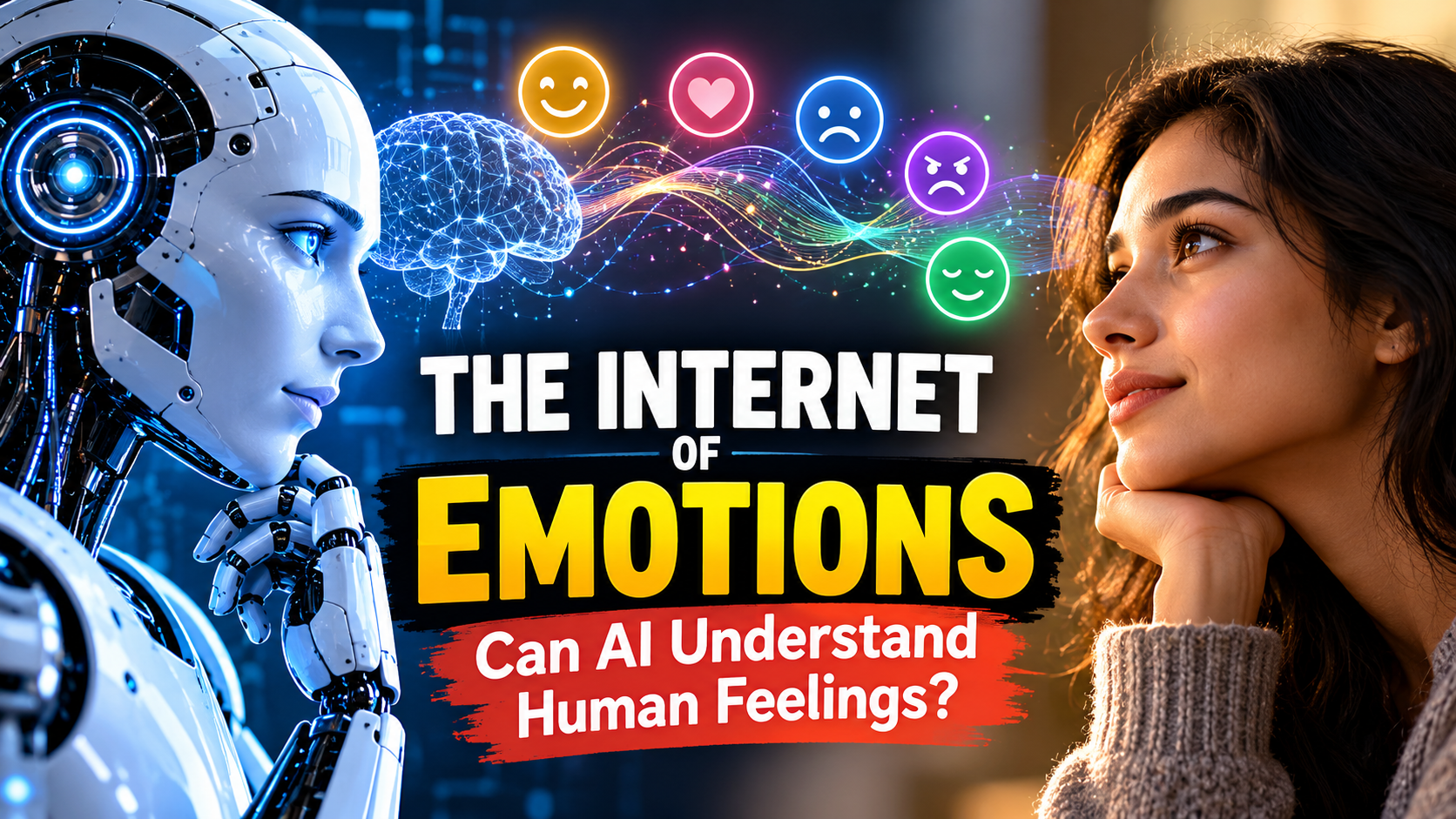
The Internet of Emotions is a conceptual term describing a connected digital environment in which technology can collect and analyze signals related to human emotional states.
Traditional internet technologies primarily process information such as:
The Internet of Emotions adds another layer:
emotional information.
Instead of simply asking:
“What did the user say?”
an emotionally aware system could also attempt to determine:
“How does the user appear to feel?”
For example, an AI system might analyze:
These signals could then be processed by machine-learning models to estimate an individual’s possible emotional state.
However, these are signals and predictions, not direct access to someone’s inner experience.
AI doesn’t have a magical sensor that can directly read the human mind.
Instead, emotion-recognition systems generally work by analyzing observable data.
AI can analyze written language to identify emotional patterns.
For example:
“I finally got the job I’ve been waiting for!”
The system may detect language associated with excitement or happiness.
Meanwhile:
“Nothing seems to be working anymore.”
may contain patterns associated with frustration, sadness, or hopelessness.
Natural Language Processing (NLP) allows AI systems to examine:
This is often called sentiment analysis or emotion classification.
But context matters.
Consider the sentence:
“Great, another meeting.”
Depending on the context, “Great” could represent genuine happiness or sarcasm.
This illustrates one of the biggest challenges in emotion AI:
The same words can communicate completely different emotions.
Human voices contain information beyond the words being spoken.
AI can analyze characteristics such as:
For example, someone who is nervous might speak differently from someone who is relaxed.
A person’s voice may also change when they are:
AI can use machine-learning models to identify statistical patterns associated with these states.
However, voice emotion detection is not perfect.
People have different natural speaking styles, accents, cultures, personalities, and communication habits.
A person speaking loudly isn’t necessarily angry.
Someone speaking quietly isn’t necessarily sad.
Computer vision allows AI systems to analyze faces and identify patterns in facial movements.
A system may examine features such as:
These signals can sometimes provide clues about emotional states.
For example, a smile may be associated with happiness.
But even facial expressions require context.
People smile when they are:
Therefore, a facial expression alone cannot reliably tell the complete emotional story.
The Internet of Emotions could become much more powerful when AI receives data from wearable devices.
Smartwatches and other sensors can potentially collect information such as:
AI could combine this information with other signals.
For example:
Voice + facial expression + heart-rate changes + context
could provide a richer picture than any one signal alone.
But physiological signals are also ambiguous.
An elevated heart rate could result from:
Therefore, AI still has to interpret the data within context.
Another important component is behavioral data.
AI systems can potentially analyze how people interact with digital platforms.
Examples include:
Imagine a person who normally writes long messages but suddenly begins responding with one-word answers.
An AI could detect the behavioral change.
But detecting a change does not automatically explain why it happened.
The person might be:
This distinction is extremely important.
This is the central question.
The answer depends on what we mean by “understand.”
There are at least two different meanings.
AI can identify patterns that are statistically associated with certain emotional states.
For example:
“This person’s speech patterns resemble patterns commonly associated with stress.”
Humans actually experience emotions.
We don’t simply classify happiness. We feel happiness.
We don’t merely identify fear. We experience fear through our minds and bodies.
Current AI systems do not have human emotional experiences in the same sense humans do.
Therefore, it is more accurate to say:
AI can model and predict aspects of emotional expression, but that is different from experiencing emotions itself.
This distinction becomes particularly important with conversational AI.
An AI assistant may say:
“I’m sorry you’re going through this. That sounds difficult.”
The response may feel empathetic.
But does the AI actually feel sadness or compassion?
No—not in the human experiential sense.
The system generates a response based on learned patterns and the context of the conversation.
This can still be useful.
A tool doesn’t necessarily need to experience an emotion to provide a helpful response to someone experiencing that emotion.
However, users should understand the distinction between:
emotional simulation
and
emotional experience.
Emotion AI, also known as affective computing, refers to technologies designed to detect, interpret, process, or respond to human emotional signals.
The field involves multiple disciplines, including:
The goal is not necessarily to create machines that “feel.”
Instead, one major goal is to make technology better at interacting with humans.
For example, an AI tutor might recognize that a student is becoming frustrated and change the difficulty of an exercise.
A customer-service system might detect escalating frustration and transfer the conversation to a human representative.
A vehicle interface could potentially recognize that a driver appears distracted or stressed and adapt its alerts.
The technology could have applications across many industries.
Emotion-aware systems could potentially assist healthcare professionals by identifying changes in behavioral or emotional patterns.
Possible applications include:
However, healthcare applications require particularly strong privacy protections and professional oversight.
AI-generated emotional assessments should not automatically be treated as medical diagnoses.
Imagine an AI tutor that notices when a student repeatedly struggles with a concept.
Instead of simply repeating the same explanation, it could potentially adapt:
An emotionally responsive learning system could aim to recognize signals associated with:
The objective would be to create a more personalized learning experience.
Customer-service systems already analyze language and conversation patterns.
Emotion-aware AI could potentially identify when a customer is becoming increasingly frustrated.
Instead of continuing with automated responses, the system could:
This could make customer interactions more responsive.
The gaming industry could use emotional signals to create more adaptive experiences.
Imagine a game that adjusts its difficulty depending on how a player is interacting with it.
A game could potentially detect patterns associated with:
The game environment could then dynamically respond.
This could make interactive entertainment more personalized.
Robots designed to interact with humans could benefit from emotion recognition.
For example, a social robot might identify facial or vocal signals and modify its behavior accordingly.
Applications could include:
The challenge is making these systems helpful without creating the false impression that a machine has human feelings.
Emotion analysis could also influence advertising.
Companies may want to understand how audiences react to:
Emotion-related signals could potentially help researchers understand audience responses.
However, this area raises significant concerns about:
consent, privacy, manipulation, and surveillance.
People may not want companies to infer their emotional states simply because they interacted with digital content.
If responsibly developed, emotion-aware technology could offer several potential benefits.
Technology could become more responsive to human communication.
AI could adapt interfaces and services to different users.
Emotion-aware systems may potentially help people who have difficulty interpreting certain social cues.
Learning systems could adapt to students’ engagement and difficulties.
Systems could recognize when automated assistance is no longer sufficient.
Emotion-related context could help AI systems determine when a human should become involved.
Yes.
And this is one of the most important limitations of emotion AI.
Human emotions are complicated.
Consider someone sitting silently with a serious expression.
What does it mean?
They could be:
The same external behavior can have many explanations.
AI systems rely on patterns.
Humans interpret emotions using:
Even humans sometimes misunderstand each other’s emotions.
AI faces an even greater challenge.
Emotional expression isn’t identical across every culture or social environment.
People can differ in:
An AI trained primarily on one population may not perform equally well across all populations.
This creates a major issue:
An emotion-recognition system may produce different levels of accuracy for different groups.
Developers therefore need diverse datasets, careful evaluation, transparency, and appropriate limitations.
The Internet of Emotions could potentially generate an entirely new category of sensitive information.
Think about traditional personal data:
Name → Email → Location → Purchase history
Now imagine:
Possible emotional state → Stress indicators → Behavioral patterns → Emotional preferences
This information could become extremely sensitive.
People may not want organizations to know:
This raises an important principle:
The ability to detect emotional signals does not automatically create a right to collect them.
Consent and privacy protections will become increasingly important as emotion-aware technologies develop.
Potentially, yes.
Suppose an advertising system detects that a person is emotionally vulnerable.
A highly personalized system could theoretically use that information to influence what the person sees.
This creates an ethical question:
Where does personalization end and manipulation begin?
The issue becomes even more sensitive when emotional data is used in areas such as:
The more sensitive the decision, the more important transparency and human oversight become.
Not automatically.
An AI can generate extremely convincing emotional language.
It may say:
“I understand how you feel.”
But users should distinguish between:
“The AI has identified patterns associated with your emotional state.”
and
“The AI has experienced your emotion.”
These are fundamentally different claims.
The first can be technically meaningful.
The second is a much deeper philosophical question.
This topic goes beyond technology.
If one day a machine behaves exactly like an emotionally intelligent human, does that mean it actually feels?
This question connects AI with philosophy of mind.
Consider three possibilities.
AI could become extremely sophisticated at recognizing and simulating emotions while never experiencing them.
Future AI architectures might potentially produce forms of internal states that could be considered machine emotions.
Even if a future AI claims:
“I feel fear.”
how could humans prove whether it actually experiences fear?
This is part of the broader problem of other minds.
We cannot directly experience another person’s consciousness either.
We infer it from behavior and communication.
That makes machine consciousness an extraordinarily complex question.
Human emotional intelligence involves much more than recognizing facial expressions.
It can include:
AI can reproduce some aspects of these behaviors.
But human emotional intelligence develops through:
AI systems operate differently.
Therefore, comparing AI emotion recognition directly with human emotional intelligence can be misleading.
Imagine a future where emotional signals are integrated across digital devices.
You wake up.
Your wearable detects changes in your sleep and physiological patterns.
Your phone recognizes that your communication style appears different.
Your AI assistant adjusts its interaction style.
During work, your computer notices signs associated with fatigue.
Your learning platform changes the pace of training.
Your car detects possible distraction and modifies its alerts.
At home, your smart environment adjusts lighting or sound based on your preferences.
This could create a deeply personalized digital environment.
But there is another possible future:
A world where companies, platforms, employers, or governments have unprecedented access to emotional information.
The same technology could therefore produce convenience or surveillance, depending on how it is designed and governed.
One of the most realistic directions for AI may not be machines actually experiencing human emotions.
Instead, AI may become increasingly good at understanding emotional context.
For example:
User: “I failed my exam.”
A basic AI may provide information about exams.
A context-aware AI may recognize that the user may be disappointed and respond more appropriately.
The difference is subtle but important.
The AI doesn’t need to feel disappointment.
It needs to understand that disappointment may be relevant to the conversation.
This could make future AI systems more useful without requiring them to possess human-like consciousness.
As emotion-aware AI becomes more advanced, society may need stronger rules around emotional data.
Important principles could include:
People should know when their emotional signals are being analyzed.
Organizations should collect only the information genuinely required for a specific purpose.
Users should understand what an AI system is analyzing and how the result is being used.
High-impact decisions should not automatically depend on AI emotion predictions.
Emotional and physiological information should receive strong security protections.
People should have meaningful choices about whether their emotional information is collected.
In a limited sense, yes.
Modern technologies already attempt to infer aspects of human emotion through:
However, the idea of a fully connected Internet of Emotions remains more of a developing concept than a universally established technological system.
Today’s systems are still limited by:
So we are not yet living in a world where AI can reliably “read minds.”
Perhaps the most important question isn’t:
“Can AI understand emotions?”
A better question may be:
“How should humans use technology that can increasingly infer emotional information?”
Technology itself is only part of the story.
The larger issue is how humans choose to design, deploy, regulate, and use it.
An emotion-aware AI could become:
A helpful assistant
or
A powerful surveillance tool.
The difference may depend less on the algorithm itself and more on the rules surrounding it.
The Internet of Emotions represents one of the most fascinating intersections between artificial intelligence and human behavior.
AI can already analyze emotional signals in text, speech, facial expressions, physiological measurements, and behavioral patterns. These technologies could potentially transform education, healthcare, customer service, accessibility, entertainment, and human-computer interaction.
But there is an important distinction:
Recognizing an emotional pattern is not the same as experiencing an emotion.
AI can estimate what someone may be feeling based on observable signals, but human emotions are deeply contextual, personal, cultural, and complex.
The future of emotionally intelligent technology therefore shouldn’t simply focus on making AI better at recognizing feelings.
It should also focus on:
privacy, consent, transparency, fairness, security, and human control.
Perhaps the most interesting future isn’t one where machines become human.
It may be one where machines become better at understanding the human context in which they operate—without pretending to possess the human experience itself.
The Internet of Emotions could ultimately change the relationship between humans and technology.
The question is not only whether AI can understand us.
The bigger question is whether we can build a future where that understanding is used responsibly.
The Internet of Emotions is a concept involving technologies that collect and analyze signals related to human emotional states through sources such as text, voice, facial expressions, physiological data, and behavior.
AI can recognize patterns associated with emotions and make predictions about someone’s possible emotional state. However, this should not be confused with experiencing emotions like a human.
Emotion AI refers to artificial-intelligence technologies designed to detect, interpret, process, or respond to human emotional signals.
No. Current AI systems do not literally read human thoughts. They analyze observable data and make predictions based on learned patterns.
AI can analyze text, speech, facial expressions, body movements, physiological signals, and behavioral patterns to estimate possible emotional states.
No. Emotional signals are ambiguous and can vary between individuals, cultures, situations, and contexts.
Major concerns include privacy, surveillance, inaccurate predictions, bias, discrimination, manipulation, data security, and inappropriate use of sensitive emotional information.
There is currently no definitive answer to whether future AI could possess genuine subjective emotional experiences. This remains an open scientific and philosophical question.
Potential applications include education, healthcare, customer service, accessibility, robotics, gaming, automotive systems, entertainment, and human-computer interaction.
Some components already exist, including sentiment analysis, speech-emotion analysis, facial-expression analysis, wearable sensing, and conversational AI. However, a fully integrated Internet of Emotions remains a developing concept.
AI may learn to recognize the signals of human emotions. But understanding what it means to actually feel those emotions remains one of the deepest questions at the intersection of technology, psychology, neuroscience, and philosophy.
What do you think?
Could machines eventually understand human emotions as deeply as humans do—or will emotional intelligence always remain uniquely human?
Advice Share is a research-based knowledge platform exploring fascinating questions across humans, nature, science, technology, history, and the universe.
Our goal is to make complex ideas easier to understand through research-driven and educational content.
Explore more knowledge with Advice Share.