Physical Address
Mumbai, Maharashtra - 400037
Physical Address
Mumbai, Maharashtra - 400037

Introduction
In today’s world full of information, opinions, and misinformation, two skills can completely transform your thinking: Scientific Thinking and Critical Thinking
👉 Scientific Thinking
👉 Critical Thinking
These are not just academic concepts—they are life skills that help you make better decisions, avoid manipulation, and understand reality more clearly.
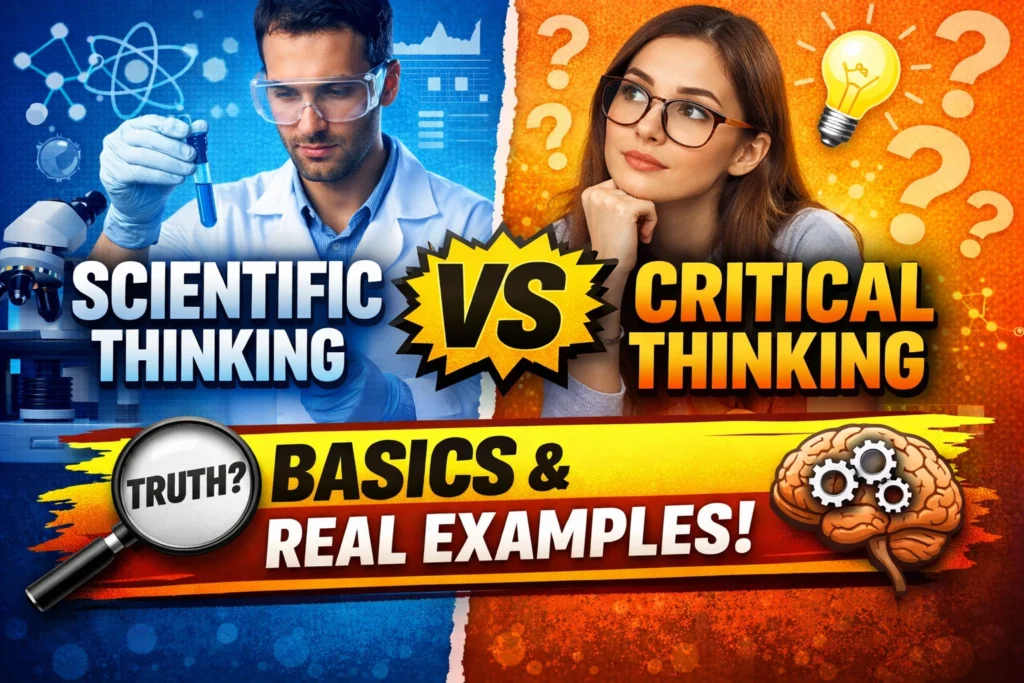
If you master these, you don’t just gain knowledge—you gain clarity, logic, and independence of thought.
Scientific thinking is a systematic and evidence-based way of understanding how the world works. It follows a structured approach known as the scientific method.
Instead of guessing or believing blindly, scientific thinking asks:
👉 “What does the evidence say?”
Everything begins with noticing something.
Example:
Plants in sunlight grow faster than those in shade.
Turn observation into a question.
👉 Why do plants grow faster in sunlight?
Make a testable assumption.
👉 “Sunlight increases photosynthesis, leading to faster growth.”
Test your hypothesis in a controlled way.
Measure results objectively.
Analyze results and decide:
A true scientific result should be repeatable by others.
Critical thinking is the ability to analyze, evaluate, and question information before accepting it as true.
It protects you from:
👉 It asks: “Is this really true?”
Break down information.
👉 What is actually being said?
Check reliability.
👉 Is the source trustworthy?
Check if arguments make sense.
👉 Does the conclusion follow the evidence?
Don’t accept things blindly.
👉 What if this is wrong?
Recognize:
Make informed, rational decisions.
| Aspect | Scientific Thinking | Critical Thinking |
| Purpose | Discover truth through experiments | Evaluate truth through logic |
| Approach | Scientific method | Logical reasoning |
| Focus | Data & testing | Arguments & analysis |
| Use | Science, research | Daily life, decision making |
👉 Simple understanding:
These two skills are powerful when combined: Scientific Thinking and Critical Thinking
👉 Example:
A study says: “80% of people benefited from a product”
Scientific Thinking and Critical Thinking
Use logic, not impulse.
👉 Truth = Evidence + Logic
Scientific thinking and critical thinking are not optional skills anymore—they are essential tools for survival in the modern world.
👉 When you combine both Scientific Thinking and Critical Thinking, you become:
“Don’t just learn what to think—learn how to think.”