













































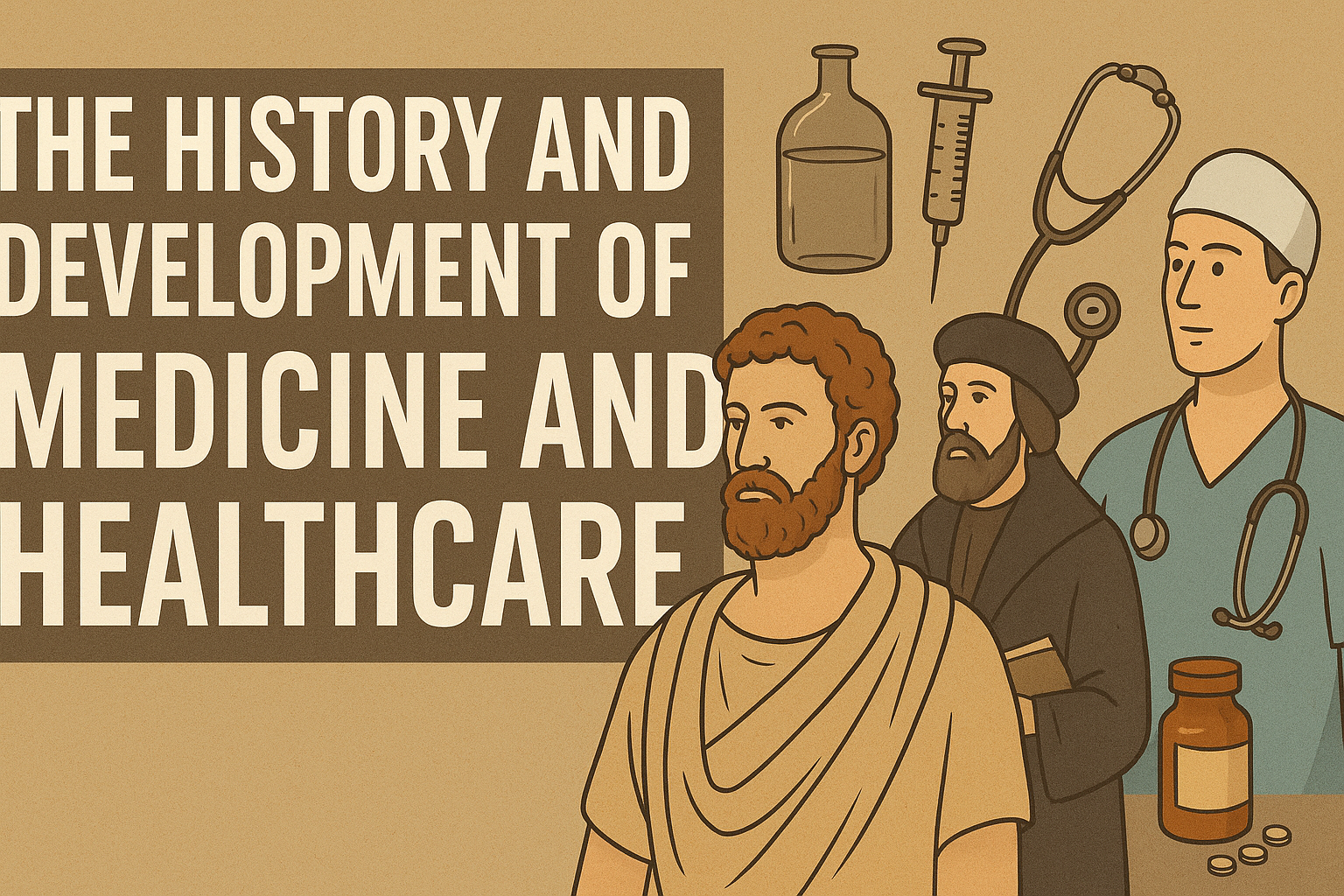

Medicine and healthcare have a long and fascinating history, spanning thousands of years and countless civilizations. From ancient herbal remedies and primitive surgical techniques to modern medical breakthroughs, the development of medicine and healthcare has been a continuous process of discovery, innovation, and improvement. In this article, we’ll explore the history of medicine and healthcare, tracing its evolution from its earliest roots to the present day.
Ancient Medicine
The earliest known medical texts date back to ancient civilizations like Egypt, Greece, and China. The Egyptian Ebers Papyrus, for example, is a collection of medical prescriptions and treatments dating back to 1550 BCE. The Greeks, meanwhile, made significant contributions to medicine through the works of Hippocrates, the “father of modern medicine,” who emphasized the importance of observation and empirical evidence in medical practice. Chinese medicine also emerged during this time, with practitioners using acupuncture, herbal remedies, and other therapies to treat a range of ailments.
Medieval Medicine
During the Middle Ages, medicine in Europe was heavily influenced by the teachings of the Greek physician Galen, who believed in the importance of balance and harmony in the body. Medical practices during this time were often based on superstition and religious belief, with many treatments relying on prayers, charms, and potions. However, the development of universities and the growth of scientific knowledge during the Renaissance led to significant advances in medicine, including the discovery of the circulation of blood by William Harvey and the development of the microscope by Antonie van Leeuwenhoek.
Modern Medicine
The 19th and 20th centuries saw the birth of modern medicine, with significant advances in surgical techniques, disease prevention, and the development of new medications. The discovery of antibiotics, for example, revolutionized the treatment of infectious diseases, while the development of vaccines helped to prevent the spread of deadly illnesses like smallpox and polio. The field of psychiatry also emerged during this time, with new treatments for mental illness such as psychotherapy and medication.
Recent Developments in Healthcare
In the 21st century, medicine and healthcare continue to evolve at a rapid pace. New technologies like genomics and personalized medicine are allowing doctors to tailor treatments to individual patients based on their unique genetic makeup, while advances in artificial intelligence and machine learning are helping to improve diagnostics and treatment decisions. The COVID-19 pandemic has also highlighted the importance of healthcare and public health, with rapid development of new vaccines and treatments to combat the virus.
Conclusion
The history of medicine and healthcare is a story of human ingenuity and innovation, as people throughout history have sought to understand and treat the human body and mind. From the earliest herbal remedies to the most advanced medical technologies of today, the field of medicine has come a long way. While there is still much to learn and discover, the future of healthcare looks bright, with the potential to cure diseases that were once thought incurable and to improve the quality of life for people around the world.
The influence of religion on world history
Religion has been a driving force in world history since the dawn of civilization. From the earliest hunter-gatherer societies to the complex societies of the present day, religion has played a central role in shaping cultures, influencing politics, and shaping the course of human events.
One of the earliest examples of the influence of religion on world history can be found in the ancient civilizations of the Near East, such as Mesopotamia, Egypt, and Persia. These societies developed complex religious beliefs and practices that were intertwined with their political and economic systems. For example, in ancient Egypt, the pharaoh was seen as a divine figure, responsible for maintaining Ma’at, or the balance of the universe. In Mesopotamia, the king was seen as a representative of the gods, responsible for maintaining order and justice.
Religion continued to play a central role in the development of Western civilization. Christianity, which emerged in the first century CE, became the dominant religion of Europe, and its influence extended beyond the continent to the Americas and other parts of the world. Christianity played a crucial role in shaping the political and social systems of medieval Europe, and its teachings influenced the development of science, philosophy, and the arts.
In the 16th century, the Protestant Reformation challenged the authority of the Catholic Church and led to the establishment of new Christian denominations. This period of religious turmoil also contributed to the development of modern nation-states and the rise of capitalism.
Religion has also played a major role in shaping the history of Asia. Buddhism, which emerged in India in the 6th century BCE, spread throughout Asia and became a major cultural and religious force in many countries, including China, Japan, and Korea. In China, Confucianism and Taoism played important roles in shaping the country’s political and social systems.
In the Islamic world, religion has played a central role in shaping the political and social systems of many countries. The spread of Islam in the 7th and 8th centuries led to the development of a vast Islamic empire that extended from Spain to India. Islamic civilization made significant contributions to science, philosophy, and the arts, and its influence can be seen in the development of Western civilization.
Religion has also been a major factor in the conflicts and wars that have shaped world history. The Crusades, a series of wars fought between Christians and Muslims in the Middle Ages, were motivated by religious and political factors. The Thirty Years’ War, fought in Europe in the 17th century, was sparked by religious conflicts between Protestants and Catholics.
In the 20th century, religion continued to play a major role in shaping world events. The rise of fascism in Europe and the events leading up to World War II were shaped in part by religious and ideological factors. The Cold War, which dominated international politics for much of the second half of the 20th century, was fueled in part by the ideological conflict between communism and capitalism.
Today, religion continues to influence the course of world events. The rise of Islamic fundamentalism and the ongoing conflicts in the Middle East are rooted in religious and political factors. The influence of religion can also be seen in the ongoing debates over issues such as abortion, gay rights, and the role of religion in public life.
In conclusion, religion has played a central role in shaping world history, from the earliest civilizations of the Near East to the complex societies of the present day. Religion has influenced politics, economics, culture, and the course of human events, and its impact can still be seen in the world around us.