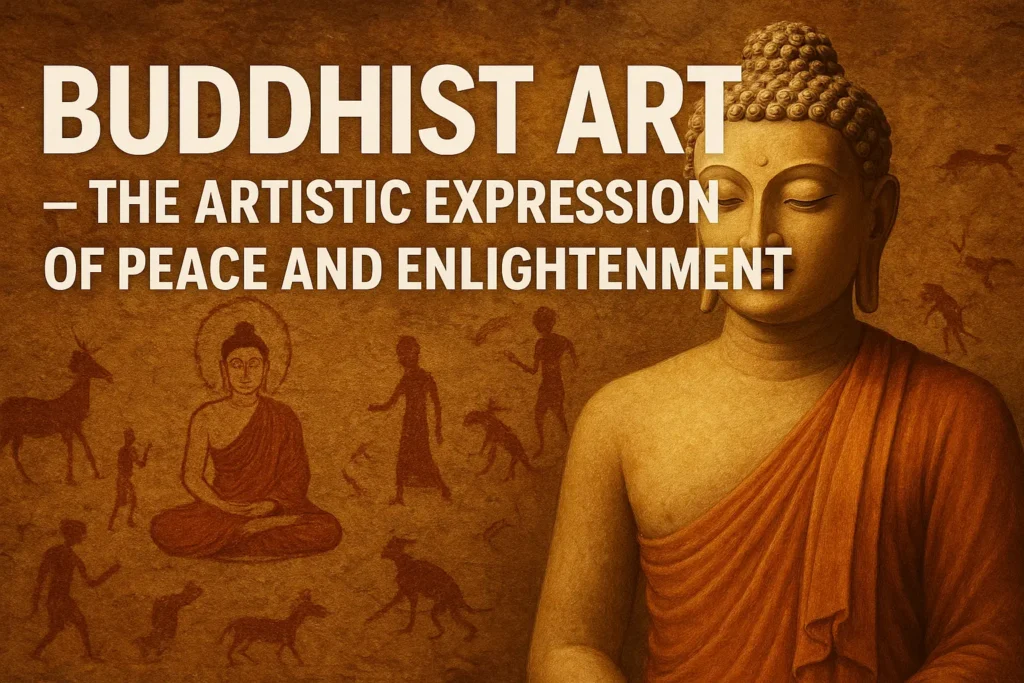
Buddhist art refers to the visual art inspired by the life, teachings, and principles of Gautama Buddha. It developed as Buddhism spread from India to other parts of Asia — including Sri Lanka, Nepal, Tibet, China, Japan, Thailand, and Myanmar — each region adding its unique artistic style and symbolism.
Buddhist art is not just decorative; it is a spiritual expression meant to inspire peace, compassion, and the path toward enlightenment.
Origin of Buddhist Art
Buddhist art began around the 5th–4th century BCE, after the death (Mahaparinirvana) of the Buddha. In the early stages, Buddha was not shown in human form. Instead, his presence was symbolized through:
The Bodhi Tree (enlightenment)
The Wheel (Dharmachakra) – the turning of the law
Footprints – symbolizing his presence
The Empty Throne – representing his absence after nirvana
Later, during the Kushan period (1st–3rd century CE), artists started depicting Buddha in human form — especially in Gandhara and Mathura art schools.
Major Schools of Buddhist Art
1. Gandhara School of Art
Region: Northwest India (now Pakistan and Afghanistan)
Influence: Greek and Roman (Hellenistic style)
Features:
Realistic human forms
Curly hair, sharp facial features
Draped robes resembling Greek togas
Famous Example: Standing Buddha of Gandhara
2. Mathura School of Art
Region: Northern India (Uttar Pradesh)
Influence: Indigenous Indian style
Features:
Strong, rounded figures
Smiling face with spiritual calmness
Thin robe closely fitted to the body
Famous Example: Seated Buddha at Mathura
3. Amaravati School of Art
Region: South India (Andhra Pradesh)
Material: White marble
Features:
Beautiful relief carvings
Narrative scenes from Buddha’s life and Jataka tales
Graceful and dynamic human figures
Famous Example: Sculptures from the Amaravati Stupa
Forms of Buddhist Art
1. Stupas
Dome-shaped structures built over sacred relics of Buddha.
Symbolize the universe and the path to enlightenment.
Famous stupas: Sanchi Stupa, Amaravati Stupa.
2. Sculptures and Statues
Represent Buddha in various mudras (hand gestures) such as:
Dharmachakra Mudra – teaching
Bhumisparsha Mudra – calling the earth to witness
Dhyana Mudra – meditation
3. Paintings and Murals
Found in ancient caves like Ajanta and Ellora (Maharashtra, India).
Show stories from the Jataka tales and scenes from Buddha’s life.
Rich colors, graceful figures, and deep spiritual expression.
4. Symbols in Buddhist Art
Common symbols used include:
Lotus Flower – purity and enlightenment
Wheel (Dharmachakra) – the cycle of birth and rebirth
Lion – courage and strength of Buddha’s teachings
Bodhi Tree – enlightenment
Stupa – sacred mind of Buddha
Spread of Buddhist Art
As Buddhism spread, each culture created its own version of Buddhist art:
Tibet: Mandalas, thangkas (scroll paintings)
China: Stone cave carvings (Longmen, Yungang)
Japan: Zen ink paintings, wooden Buddha statues
Thailand & Myanmar: Golden Buddha images and temples
Despite regional differences, all Buddhist art expresses peace, compassion, and spiritual awakening.
Conclusion
Buddhist art is a journey from symbolism to spirituality — from early symbols like the wheel and lotus to magnificent statues and paintings across Asia. It reminds humanity of the path of peace, mindfulness, and enlightenment taught by the Buddha over 2,500 years ago.