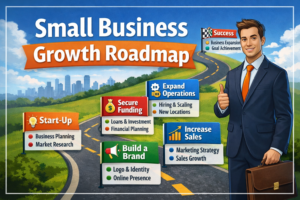
Introduction: What Growth Really Means for a Small Business
Small business growth is not just about increasing sales. True growth means:
- Consistent revenue
- Predictable cash flow
- Strong brand presence
- Loyal customers
- Stable systems and processes
- Reduced dependency on the owner
Most small businesses fail to grow because they jump into marketing or scaling without building a strong foundation. This roadmap solves that problem by following a structured, proven path.
Phase 1: Foundation & Business Clarity
1.1 Business Vision & Direction
Every growing business starts with clarity.
You must define:
- Why your business exists
- What problem it solves
- Where you want the business to be in 3–5 years
Action Points
- Write a clear mission statement
- Define long-term and short-term goals
- Decide whether your focus is profit, scale, lifestyle, or impact
Without clarity, growth becomes random and unstable.
1.2 Market & Customer Research
Growth is impossible if you don’t deeply understand your customer.
Key Areas
- Target audience demographics
- Customer pain points
- Buying behavior
- Decision-making triggers
- Price sensitivity
Action Points
- Create 1–2 ideal customer profiles
- Study competitors: pricing, offers, messaging
- Talk to real customers and gather feedback
Businesses grow faster when they sell solutions, not products.
1.3 Business Model & Revenue Structure
Your business model decides how scalable your business can be.
Define Clearly
- What exactly you sell
- How you make money
- One-time vs recurring revenue
- Fixed and variable costs
- Profit margins
Action Points
- Optimize pricing for profitability
- Remove low-margin offerings
- Add upsells or bundles where possible
Phase 2: Branding & Market Positioning
2.1 Building a Strong Brand Identity
Branding is not just a logo. It is how people perceive and trust your business.
Core Brand Elements
- Business name and tagline
- Logo and color palette
- Brand voice and tone
- Visual consistency
Action Points
- Keep branding simple and professional
- Maintain consistency across all platforms
- Focus on trust and credibility
2.2 Positioning & Differentiation
Customers should immediately understand:
“Why should I choose this business over others?”
Positioning Strategy
- Identify your Unique Selling Proposition (USP)
- Highlight outcomes, not features
- Solve a specific problem better than competitors
Clear positioning reduces price comparison and increases conversions.
Phase 3: Product or Service Optimization
3.1 Product / Service Validation
Before scaling, your offering must be validated.
Key Focus
- Customer satisfaction
- Quality consistency
- Delivery timelines
- Ease of use or experience
Action Points
- Collect reviews and testimonials
- Improve weak areas based on feedback
- Standardize delivery processes
3.2 Pricing, Offers & Packaging
Pricing directly impacts growth and sustainability.
Smart Pricing Includes
- Competitive analysis
- Value-based pricing
- Clear packages (Basic, Standard, Premium)
Action Points
- Avoid underpricing
- Introduce bundles and retainers
- Increase average order value
Phase 4: Online Presence & Digital Setup
4.1 Website & Digital Infrastructure
A professional website is your 24/7 salesperson.
Essential Elements
- Clear services/products
- Strong call-to-actions
- Contact forms and lead capture
- Trust signals (testimonials, certifications)
Action Points
- Optimize for mobile and speed
- Focus on clarity over design complexity
- Track visitor behavior
4.2 Local & Online Visibility
Visibility brings opportunities.
Key Channels
- Google Business Profile
- Online directories
- Reviews and ratings
- Social proof
Action Points
- Encourage happy customers to leave reviews
- Respond to all feedback professionally
- Maintain accurate business information everywhere
Phase 5: Marketing & Customer Acquisition
5.1 Organic Marketing Strategy
Organic growth builds long-term authority.
Channels
- Content marketing (blogs, videos)
- SEO
- Social media consistency
Action Points
- Educate before selling
- Solve customer problems through content
- Be consistent, not viral-focused
5.2 Paid Marketing Strategy
Paid ads accelerate growth when systems are ready.
Platforms
- Search ads
- Social media ads
- Retargeting campaigns
Action Points
- Start with small budgets
- Test creatives and messaging
- Track cost per lead and ROI
5.3 Lead Generation System
Growth requires a predictable flow of leads.
System Includes
- Lead magnets
- Funnels
- Email or WhatsApp follow-ups
Action Points
- Automate follow-ups
- Nurture leads before selling
- Build long-term relationships
Phase 6: Sales Process & Conversion
6.1 Sales System Design
A good product still needs a strong sales process.
Key Components
- Inquiry handling script
- Qualification process
- Follow-up system
- Closing framework
Action Points
- Respond quickly to inquiries
- Educate instead of pushing
- Track conversion rates
6.2 Customer Experience & Retention
Retention is cheaper than acquisition.
Focus Areas
- Smooth onboarding
- Clear communication
- Ongoing support
Action Points
- Ask for feedback regularly
- Offer loyalty benefits
- Turn customers into brand advocates
Phase 7: Operations & Process Management
7.1 Systemization & Automation
Growth fails without systems.
Important Systems
- Task workflows
- Documentation (SOPs)
- Automation tools
Action Points
- Reduce manual work
- Improve efficiency
- Ensure consistent quality
7.2 Financial Management
Cash flow is the lifeline of growth.
Track
- Monthly revenue
- Expenses
- Profit margins
- Cash reserves
Action Points
- Separate personal and business finances
- Plan for taxes and reinvestment
- Monitor financial health monthly
Phase 8: Team Building & Delegation
8.1 Hiring & Team Structure
You cannot scale alone.
Hiring Options
- Freelancers
- Part-time staff
- Full-time employees
Action Points
- Hire for outcomes, not tasks
- Clearly define roles
- Delegate before burnout
8.2 Leadership & Culture
Strong culture supports long-term growth.
Focus On
- Clear communication
- Accountability
- Learning mindset
Phase 9: Scaling & Expansion
9.1 Scaling Strategies
Scale only after systems are stable.
Options
- New services or products
- New markets
- Strategic partnerships
Action Points
- Scale one channel at a time
- Manage risks carefully
- Invest in technology
Phase 10: Monitoring, Analytics & Optimization
10.1 Performance Tracking
What gets measured gets improved.
Key Metrics
- Revenue growth
- Conversion rates
- Customer lifetime value
- Retention rate
Action Points
- Monthly and quarterly reviews
- Data-driven decisions
- Continuous optimization
Common Mistakes to Avoid
- Scaling without systems
- Ignoring customer feedback
- Poor cash flow management
- Over-dependence on one marketing channel
Conclusion: Sustainable Growth Mindset
Small business growth is a long-term process, not a shortcut. Businesses that grow sustainably focus on:
- Clarity
- Systems
- Consistency
- Customer value
Follow this roadmap step by step, and growth becomes predictable, manageable, and scalable.
Reader: 106