Physical Address
Mumbai, Maharashtra - 400037

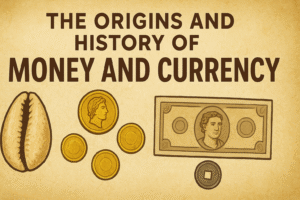
The concept of money has been central to human civilization for thousands of years. Money and currency have played a vital role in facilitating trade and commerce, as well as in shaping the political and economic systems of different societies.
The Origins of Money:
The origins of money can be traced back to the earliest human societies. In these societies, bartering was the primary method of trade. Bartering involved exchanging goods or services for other goods or services without the use of a standard unit of exchange. However, bartering had its limitations, as not all goods were easily exchangeable, and the lack of a standardized unit of exchange made it difficult to compare the value of different goods.
Over time, societies began to develop their own systems of exchange, such as using shells, beads, and other items as a form of currency. These early forms of currency were based on the value of the material they were made of or the rarity of the item.
The History of Currency:
The use of metal coins as currency dates back to ancient civilizations such as Greece and Rome. These civilizations minted coins made of precious metals such as gold, silver, and bronze, which were valued based on their weight and purity.
In the Middle Ages, paper money was introduced in China as a way to simplify trade and commerce. These early paper notes were backed by precious metals, and their value was guaranteed by the issuing authority. Paper money later spread to Europe and other parts of the world, and it eventually became the primary form of currency in most countries.
During the early modern period, international trade and commerce began to expand rapidly, leading to the need for a standardized system of currency exchange. In the 19th century, the gold standard was introduced, which linked the value of currency to the price of gold. This system was used by many countries until the early 20th century, when the gold standard was abandoned due to the economic disruptions caused by World War I.
Today, most countries use a system of fiat currency, which is not backed by any physical commodity but is instead guaranteed by the issuing authority. In this system, the value of currency is determined by supply and demand, and it can be influenced by factors such as inflation, interest rates, and economic growth.
The Evolution of Currency:
In recent years, the development of digital technology has led to the emergence of new forms of currency, such as cryptocurrency. Cryptocurrency is a digital asset that uses encryption techniques to secure transactions and control the creation of new units. Bitcoin, which was created in 2009, is the most well-known example of cryptocurrency.
While cryptocurrency has gained popularity in recent years, it has also faced criticism and regulatory challenges. Some experts argue that it is too volatile and lacks the stability and security of traditional forms of currency.
In conclusion, the history of money and currency is a long and complex one, dating back to the earliest human societies. Over time, different societies have developed their own systems of exchange, from bartering to metal coins and paper money. Today, most countries use fiat currency, but the emergence of digital technology has led to new forms of currency such as cryptocurrency. As the world continues to evolve, it is likely that the concept of money and currency will continue to evolve as well.