Physical Address
304 North Cardinal St.
Dorchester Center, MA 02124
Physical Address
304 North Cardinal St.
Dorchester Center, MA 02124

The Indian textile industry boasts a rich and diverse history that spans back to ancient times. It has been a significant contributor to the Indian economy for centuries, but in recent years, it has faced a period of decline. In this blog, we delve into the intricate details of the rise and fall of the Indian textile industry, exploring its historical roots, the challenges it has encountered, and the ongoing efforts to revive this once-thriving sector.
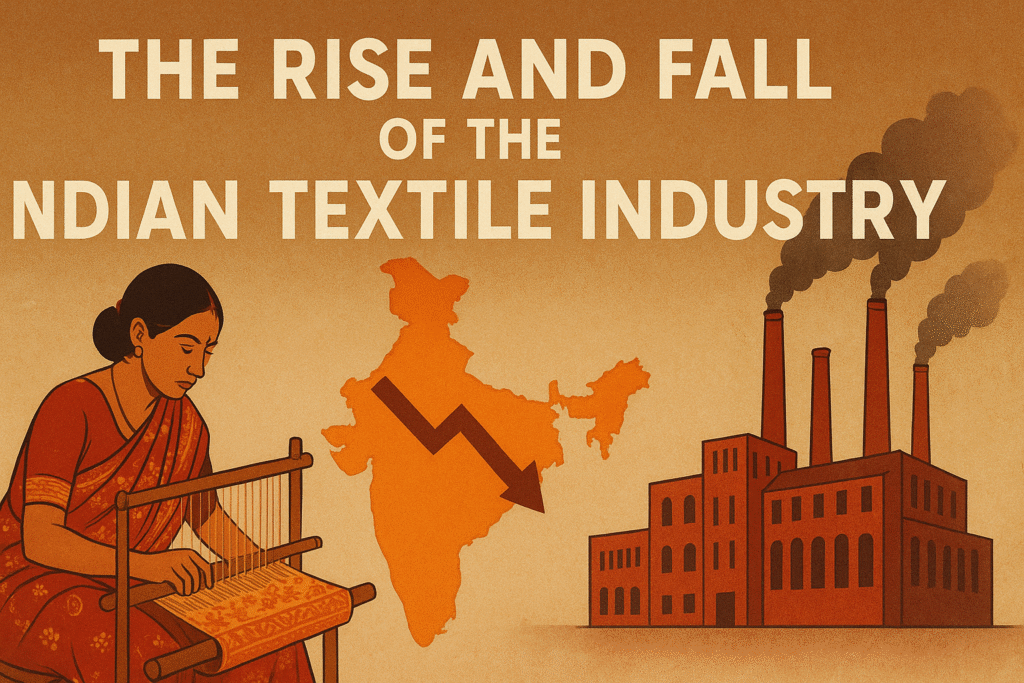
The textile industry in India can trace its origins to the ancient Indus Valley Civilization, where evidence of cotton cultivation and weaving exists. The Mughal Empire, which ruled India from the 16th to the 19th century, played a pivotal role in promoting the production of exquisite textiles like silk, muslin, and chintz. During British colonial rule, the industry witnessed significant development, culminating in the establishment of textile mills in the 19th century.
Golden Era:
The Indian textile industry reached its zenith in the 19th and early 20th centuries, becoming the world’s largest exporter of textiles. Renowned for its handloom textiles, India gained international acclaim for the intricate designs and superior craftsmanship of its fabrics. Notably, Mahatma Gandhi’s promotion of khadi, a hand-spun and hand-woven cloth, during the country’s freedom struggle added a patriotic dimension to the industry, emphasizing self-reliance and national unity.
The decline of the Indian textile industry commenced in the mid-20th century with the advent of synthetic fibers and the shift towards industrialization. Power looms and automated machinery replaced the labor-intensive handloom sector, significantly impacting its contribution to the overall industry. Additionally, the liberalization policies and economic reforms implemented in the 1990s further affected the textile industry by removing import restrictions and exposing it to fierce international competition.
Recent years have been particularly challenging for the Indian textile industry due to the COVID-19 pandemic. The unprecedented global health crisis resulted in a substantial drop in demand and disrupted supply chains. Numerous textile mills were forced to close, leading to significant job losses and adversely affecting the livelihoods of workers across the sector.
Despite the trials faced by the Indian textile industry, determined efforts are underway to revive and rejuvenate this vital sector. The government has introduced initiatives such as the Make in India campaign and the National Handloom Development Programme to promote domestic textile production and create new employment opportunities. Additionally, there is a growing emphasis on sustainable and eco-friendly textiles, with increased support for handloom and organic cotton fabrics.
The Indian textile industry has a storied past but has faced substantial challenges in recent years. However, with dedicated initiatives and a renewed focus on sustainable practices, there is hope for its revival. The future of the Indian textile industry lies in its ability to adapt, innovate, and balance the rich heritage of its traditional craftsmanship with modern advancements, ensuring the continued growth and success of this historically significant sector.