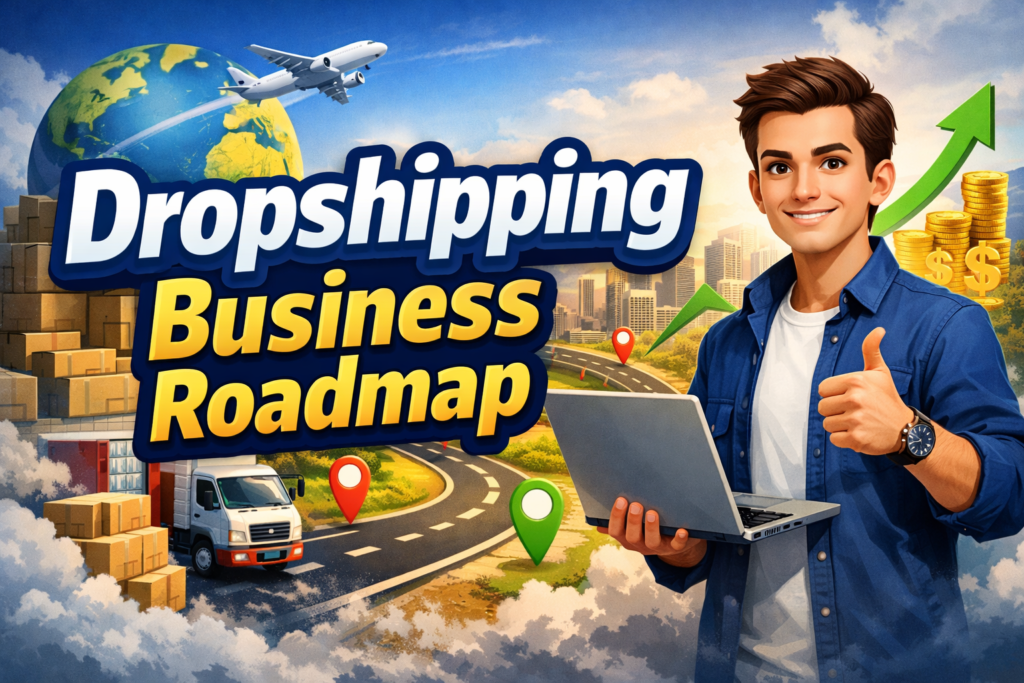
How to Start and Scale a Dropshipping Business: Complete Roadmap

Dropshipping Business Roadmap: Step-by-Step Guide to Build a Profitable Brand

Dropshipping Business Roadmap (Beginner to Brand Builder)

Dropshipping is not a “get-rich-quick” model. It is a digital retail business that rewards research, testing, systems, and patience. This roadmap takes you from zero knowledge to building a scalable, trusted brand.

How to Start and Scale a Dropshipping Business: Complete Roadmap

Phase 1: Foundation & Reality Check

1. Understanding the Dropshipping Model Deeply

Before tools and ads, you must understand how money actually flows in dropshipping.

  • How orders move from customer → store → supplier → logistics
  • Where profits are made and where they are lost
  • Difference between marketplace sellers and brand builders
  • Why most beginners fail (poor research, impatience, blind copying)
  • Setting realistic expectations (time, effort, capital)

Goal: Build clarity, not hype.

2. Market Awareness & E-Commerce Psychology

A successful store solves a specific problem for a specific audience.

  • Understanding online buyer behavior
  • Emotional vs logical buying triggers
  • Price sensitivity and impulse buying
  • Trust factors in online shopping
  • Trends vs real demand

Goal: Learn to think like a customer, not a seller.

Phase 2: Niche & Product Intelligence

3. Niche Selection (The Backbone of Success)

Choosing the wrong niche kills businesses faster than bad ads.

  • Evergreen niches vs seasonal niches
  • Passion-based vs problem-based niches
  • Audience purchasing power analysis
  • Competition depth, not just size
  • Long-term brand expansion potential

Goal: Choose a niche that can grow into a brand.

4. Product Research & Validation

A product must sell before it looks good.

  • Identifying pain-point products
  • Solving “why would someone buy this now?”
  • Analyzing competitor product pages
  • Demand validation without heavy spending
  • Profit margin calculation after ads & shipping

Goal: Reduce guesswork, increase probability.

Phase 3: Business & Brand Setup

5. Business Structure & Legal Basics

Even small stores must be built on trust.

  • Business registration awareness
  • Payment gateway requirements
  • Tax mindset (not avoidance, planning)
  • Privacy, refund & shipping policies
  • Building credibility from day one

Goal: Look legitimate, operate responsibly.

6. Brand Identity & Positioning

People don’t remember products; they remember brands.

  • Naming with clarity and recall
  • Brand story & mission
  • Visual identity (logo, colors, tone)
  • Brand voice and customer communication
  • Differentiation beyond price

Goal: Build emotional connection, not just transactions.

Phase 4: Store Creation & Experience Design

7. Platform Selection & Store Architecture

Your store is your digital showroom.

  • Platform comparison (Shopify, WooCommerce, others)
  • Domain selection psychology
  • Page structure and navigation logic
  • Mobile-first and speed optimization
  • Essential pages for trust and clarity

Goal: Make buying simple and comfortable.

8. Product Page Optimization

Most dropshipping sales are won or lost here.

  • Writing persuasive product descriptions
  • Benefit-driven storytelling
  • Image & video optimization
  • Pricing psychology and anchoring
  • FAQ sections to remove objections

Goal: Replace the salesperson with your page.

Phase 5: Fulfillment & Operations

9. Supplier Selection & Relationship Building

Suppliers are your silent partners.

  • Supplier reliability vs cheap pricing
  • Communication and responsiveness
  • Quality checks and order accuracy
  • Shipping speed expectations
  • Backup supplier strategy

Goal: Avoid customer complaints before they happen.

10. Order Management & Customer Experience

Smooth fulfillment builds trust and repeat buyers.

  • Order automation systems
  • Transparent shipping communication
  • Handling delays professionally
  • Refund and dispute management
  • Post-purchase follow-ups

Goal: Turn buyers into brand advocates.

Phase 6: Marketing & Traffic Systems

11. Organic Growth Strategies

Free traffic builds authority and long-term value.

  • SEO for product and content pages
  • Social media content strategy
  • Short-form video marketing
  • Community building
  • Email list creation

Goal: Reduce dependence on paid ads.

12. Paid Advertising & Testing Framework

Ads are data, not magic.

  • Understanding ad platforms
  • Audience targeting fundamentals
  • Creative testing methodology
  • Budget control and risk management
  • Scaling only after proof

Goal: Spend money with logic, not emotion.

Phase 7: Optimization & Scaling

13. Conversion Rate Optimization

More sales without more traffic = higher profit.

  • Checkout optimization
  • Trust badges & social proof
  • Abandoned cart recovery
  • A/B testing mindset
  • Customer behavior analysis

Goal: Increase revenue efficiency.

14. Analytics & Decision Making

Data tells the real story.

  • Key metrics that matter
  • Identifying winning vs losing products
  • Customer lifetime value analysis
  • Profit vs revenue clarity
  • Weekly and monthly review systems

Goal: Make decisions based on numbers, not hope.

Phase 8: Scaling to a Real Brand

How to Start and Scale a Dropshipping Business: Complete Roadmap

15. Brand Expansion & Automation

This is where dropshipping becomes a business.

  • Expanding product lines
  • Hiring and delegation
  • System documentation
  • Automation tools
  • Entering new markets

Goal: Work on the business, not in it.

16. Advanced & Long-Term Strategies

Moving beyond basic dropshipping.

  • Private labeling
  • Custom packaging
  • Subscription models
  • Hybrid fulfillment models
  • Exit or acquisition strategy

Goal: Build an asset, not a side hustle.

Phase 9: Mindset & Sustainability

17. Entrepreneurial Mindset

Your mindset decides your ceiling.

  • Patience and consistency
  • Handling failures and losses
  • Avoiding shiny object syndrome
  • Continuous learning
  • Ethical selling and customer respect

Goal: Stay in the game long enough to win.

Final Thought

Dropshipping success comes from systems, discipline, and customer obsession, not shortcuts.
Those who treat it like a real business build brands that last.

Leave a Reply

Your email address will not be published. Required fields are marked *

🎧 ARTICLE READER
🔊