Physical Address
304 North Cardinal St.
Dorchester Center, MA 02124
Physical Address
304 North Cardinal St.
Dorchester Center, MA 02124

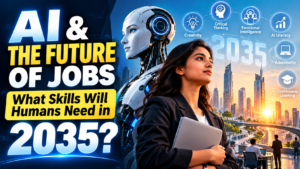
AI and the Future of Jobs is becoming one of the most important discussions about careers, technology, and the global workforce. Artificial Intelligence is changing how people work, how businesses operate, and what skills employers need.
From software development and marketing to healthcare, education, finance, manufacturing, and customer service, AI is increasingly being used to automate repetitive tasks, analyze information, generate content, and support decision-making.
But does this mean that AI will replace humans?
Not necessarily. The future of work is likely to involve a combination of human expertise and artificial intelligence. While some tasks may become automated, new roles and responsibilities can also emerge.
The important question is therefore not simply “Will AI take our jobs?” but rather:
“What skills will humans need to succeed alongside AI?”
This article explores the AI and the Future of Jobs, the skills humans are likely to need by 2035, the changing nature of employment, and how students and professionals can prepare for an increasingly AI-powered workplace.
AI is unlikely to affect every job in the same way.
A job is usually made up of many different tasks. Some tasks may be highly repetitive and predictable, while others require judgment, communication, creativity, physical activity or responsibility.
AI can potentially automate certain tasks while helping humans perform other tasks more efficiently.
For example:
This means the future of work may increasingly involve task transformation rather than simple job replacement.
The ILO’s 2025 analysis specifically concludes that, because human input remains necessary for many tasks, most jobs exposed to generative AI are more likely to be transformed than made redundant.
Some jobs and tasks will almost certainly become more automated.
However, saying that “AI will replace all human jobs” would be an unsupported conclusion.
There are several reasons.
First, AI systems still operate within technical, economic, organizational and regulatory constraints.
Second, many occupations require physical interaction, human trust, accountability, negotiation, empathy or complex contextual judgment.
Third, automation can create new tasks and occupations even while reducing demand for others.
The World Economic Forum’s 2025 research illustrates this dynamic. Employers surveyed expected significant job creation and displacement by 2030 rather than a simple collapse in total employment. Technology-related roles such as AI and machine-learning specialists, big-data specialists and software developers were among the fastest-growing roles in percentage terms.
Therefore, the future may look less like:
Humans vs. AI
and more like:
Humans + AI vs. problems that neither could solve as efficiently alone.
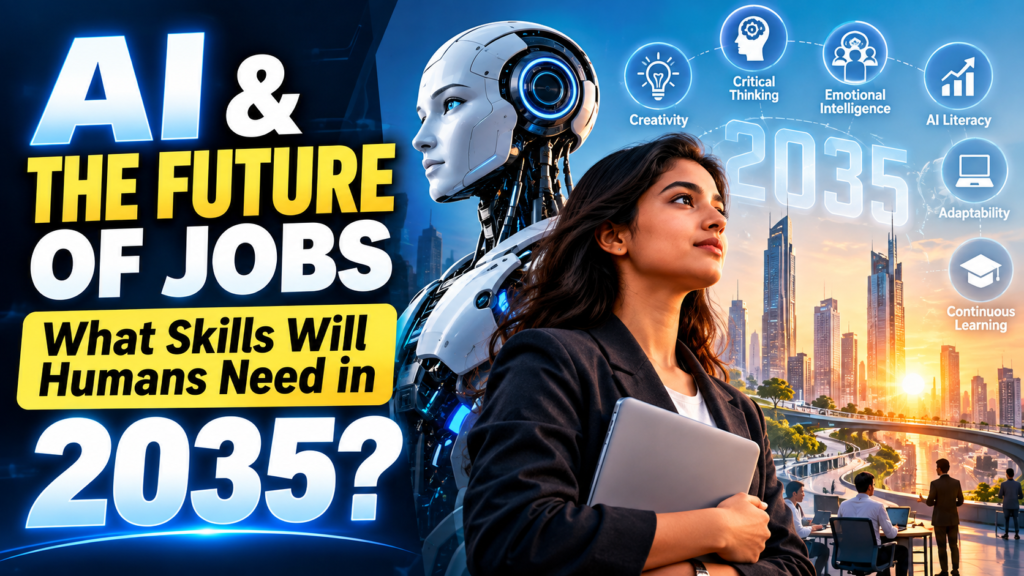
Based on current research and the direction of technological change, the following capabilities are likely to become increasingly valuable:
The World Economic Forum currently identifies analytical thinking as the leading core skill among employers surveyed, while AI and big data, networks and cybersecurity, technological literacy, creative thinking, resilience, flexibility and agility, and curiosity and lifelong learning are among the capabilities expected to rise in importance through 2030.
Let’s examine these skills individually.
One of the most important skills of the 2035 workplace may simply be understanding how AI works and how to use it effectively.
AI literacy does not necessarily mean becoming an AI researcher.
A marketing professional does not need to build a large language model from scratch.
A teacher does not necessarily need to become a machine-learning engineer.
Instead, AI literacy means understanding:
The OECD’s 2026 research on skills in the AI age highlights that adapting to AI-driven labour-market changes requires workers to develop skills aligned with changing demands.
By 2035, AI literacy may become similar to digital literacy today.
AI can generate answers extremely quickly.
But speed does not automatically equal accuracy.
People will increasingly need to evaluate AI outputs rather than simply accept them.
Critical thinking involves asking:
Analytical thinking is already one of the most important skills identified by employers.
The World Economic Forum reports that analytical thinking remains the top core skill in its 2025 employer survey, with around seven in ten companies considering it essential.
As AI becomes better at producing information, the ability to judge information may become even more valuable.
AI can generate images, videos, text, music, designs and ideas.
So why would creativity still matter?
Because creativity is not simply the ability to produce something.
It also involves:
AI can generate thousands of possible designs.
A human still needs to decide:
Which idea is meaningful?
Who is it for?
Why should it exist?
The World Economic Forum lists creative thinking among the skills expected to increase in importance toward 2030.
In an AI-powered world, creativity may shift from producing every component manually toward directing, selecting, combining and refining ideas.
AI is excellent at processing information and assisting with many well-defined tasks.
But real-world problems are rarely perfectly defined.
A strong problem solver needs to:
This process requires context and judgment.
By 2035, workers who can use AI as a problem-solving partner may be able to achieve significantly more than workers who either ignore AI or blindly follow its output.
Communication will remain a fundamentally human capability.
Even with increasingly sophisticated AI, organizations will still need people who can:
AI may help people create presentations or emails, but communication is ultimately about understanding other people.
A person who can combine AI-assisted productivity with strong communication may become particularly valuable.
Some of the most important human capabilities are difficult to reduce to instructions or algorithms.
Emotional intelligence includes:
These skills are particularly important in:
The World Economic Forum’s skills research continues to highlight human-centred capabilities such as empathy, active listening, leadership and social influence alongside technological skills.
AI may become increasingly capable of simulating conversational empathy, but organizations will still need humans to take responsibility for many human relationships and high-stakes interactions.
Perhaps the most important skill for 2035 will be the ability to learn new skills repeatedly.
Technology changes quickly.
A skill that is highly valuable today may become partially automated tomorrow.
That does not mean learning is becoming less important.
It means learning is becoming more important.
The World Economic Forum estimates that 39% of workers’ core skills could change by 2030, while 59 out of every 100 workers may need training by that point according to employers surveyed.
Future professionals will therefore need a mindset of:
Learn → Apply → Adapt → Learn again.
A degree may start a career, but continuous learning may increasingly determine how long a person remains competitive.
Modern organizations generate enormous quantities of data.
AI makes it easier to analyze that data, but people still need to understand what the numbers mean.
Data literacy includes:
The OECD reports that AI is increasing the importance of skills related to using, analysing and interpreting data.
You may not need to become a data scientist.
But understanding data will increasingly be useful across professions.
As more work becomes digital and AI-driven, cybersecurity becomes increasingly important.
Professionals will need to understand basic concepts such as:
The World Economic Forum identifies networks and cybersecurity among the fastest-growing skill areas toward 2030.
AI may improve cybersecurity capabilities, but it may also create new attack surfaces and make certain forms of cybercrime more scalable.
Digital safety will therefore become a workplace skill, not just an IT department responsibility.
The future worker may not simply “use AI.”
They may collaborate with AI systems.
This can include:
However, prompting alone should not be treated as the ultimate future skill.
A good prompt without subject knowledge can still produce a poor result.
The more powerful combination is:
Domain expertise + critical thinking + AI literacy + effective prompting.
Microsoft’s 2025 Work Trend Index described an emerging workplace model in which humans and AI agents work together, with employees increasingly expected to direct, train or manage AI systems.
As AI takes over more execution, humans may spend more time deciding:
This makes leadership increasingly important.
Future leaders may manage not only human employees but also AI systems and automated workflows.
The ability to establish goals, evaluate outcomes and take responsibility for decisions will remain important even when execution becomes increasingly automated.
AI may know a huge amount of general information.
That does not make human expertise irrelevant.
In many industries, the valuable professional will be the person who understands both:
the industry + AI.
Examples include:
This combination can create a powerful advantage.
Instead of trying to compete with AI at being a general-purpose information machine, professionals can learn how to use AI to amplify their specialized knowledge.
Modern problems are interconnected.
A business decision can affect customers, employees, technology, finances, regulations and society simultaneously.
Systems thinking means understanding relationships between different parts of a larger system.
For example, implementing an AI chatbot is not simply a technical decision.
A company may also need to consider:
The World Economic Forum includes systems thinking among the skills expected to strengthen in importance toward 2030.
AI creates opportunities, but it also creates difficult questions.
Who is responsible when AI makes a harmful decision?
How should personal data be handled?
What happens when an AI system produces biased results?
Can AI-generated content be trusted?
How should organizations disclose AI usage?
Future workers will need basic AI ethics awareness.
Responsible AI involves considering:
Technical capability without responsible judgment can create serious problems.
Some professions depend heavily on trust.
Consider:
Even if AI can provide information, people may still want human relationships in situations where trust, empathy and accountability matter.
This is why human-centred skills are unlikely to disappear simply because AI becomes more capable.
Current labour-market research already identifies several categories of roles expected to grow.
The World Economic Forum’s 2025 report lists technology-related roles such as:
It also identifies growth in areas associated with green transition, healthcare, education and frontline work.
By 2035, entirely new occupations may also emerge.
Possible categories include:
Professionals responsible for implementing and managing AI systems.
Workers who supervise AI agents and automated workflows.
Professionals responsible for ensuring AI systems are used safely and responsibly.
Roles focused on designing effective collaboration between people and intelligent systems.
Designers, filmmakers, writers and other creatives who combine human direction with generative tools.
Individuals who use AI to build businesses with smaller teams and lower operating costs.
These are possibilities rather than guaranteed job titles.
The exact occupations of 2035 cannot be known today.
AI exposure does not necessarily mean a job disappears.
Instead, some tasks within the job may become automated.
Tasks particularly suited to automation often involve:
The ILO’s 2025 research emphasizes that occupational exposure varies considerably and that many exposed jobs are more likely to undergo transformation than full replacement.
This distinction is extremely important.
A profession can survive while its daily activities change dramatically.
One of the most important changes toward 2035 may be the emergence of human-AI teams.
Imagine a small company with:
The humans would not necessarily perform every task manually.
Instead, they could:
Define → Delegate → Review → Improve → Decide.
Microsoft’s 2025 Work Trend Index describes a similar direction, with organizations increasingly exploring human-agent teams in which AI systems take on specific tasks while humans provide direction, judgment and oversight.
This could change the meaning of productivity.
The valuable employee may not be the person who manually completes the largest number of tasks.
It may be the person who can coordinate technology, people and information to produce valuable outcomes.
Students entering the workforce should think beyond simply collecting certificates.
A future-ready education could combine four layers.
Build strong foundations in:
Learn:
Develop:
Build:
A person who can demonstrate what they can actually create may have an advantage over someone who only lists theoretical knowledge.
The World Economic Forum’s research also shows that employers expect practical experience and skills assessments to remain important methods of evaluating candidates.
You do not need to wait until 2035.
The transition is already happening.
Professionals can start with five actions.
Don’t try to learn every AI application.
Identify the tools that are relevant to your profession.
For example:
Designer → AI image and design tools
Developer → AI coding assistants
Marketer → AI research, analytics and content tools
Teacher → AI lesson and learning assistants
Accountant → AI-supported financial workflows
Entrepreneur → AI research, automation and customer support
Look at your weekly routine.
Ask:
“Which tasks do I repeat every week?”
Then investigate whether AI or automation can assist with them.
This can free human time for higher-value activities.
Do not focus exclusively on technology.
Improve:
These capabilities complement technological skills.
Instead of simply saying:
“I know AI.”
Show what you have created using AI.
For example:
A portfolio provides evidence of capability.
The most dangerous mindset may be:
“I have finished learning.”
Technology makes that approach increasingly difficult.
A better mindset is:
“I know enough today to start, and I will keep learning as the environment changes.”
Here is a simple roadmap for preparing for an AI-powered future.
Learn:
Choose one professional domain.
Examples:
Then learn how AI is changing that industry.
Move beyond simple prompting.
Learn:
Develop:
The goal should not be to compete against AI at everything.
The goal should be to become someone who can use AI intelligently while contributing capabilities AI cannot easily replace.
The future workplace will probably not divide people into two groups:
AI experts and non-AI workers.
Instead, many professionals may need a combination of both technical and human capabilities.
A useful model is:
AI Skills
Domain Expertise
Critical Thinking
Creativity
Communication
Adaptability
This combination can be more powerful than any individual skill.
For example:
A person who knows AI but does not understand marketing may produce technically impressive but commercially weak campaigns.
A marketer who understands customers but refuses to use AI may work more slowly than competitors.
But a marketer who understands customers + marketing + AI + analytics + communication can potentially operate at a much higher level.
The answer may not be a single skill.
It may be the ability to combine multiple capabilities.
Imagine a future professional who can:
Understand a problem
↓
Use AI to research it
↓
Analyze the information
↓
Question the AI’s conclusions
↓
Develop creative solutions
↓
Communicate the solution
↓
Work with humans and AI agents
↓
Take responsibility for the final decision
That person is not competing with AI.
They are directing AI toward meaningful outcomes.
There is a common misconception that AI will make knowledge unnecessary.
The opposite may be true.
When AI becomes widely available, the value of knowing what questions to ask can increase.
Consider two people using the same AI system.
Person A:
“Give me a business idea.”
Person B:
“I have ₹1 lakh, three months, a specific customer group and these distribution channels. Identify five business opportunities, estimate the major risks, compare the assumptions, and show me what information I still need before making a decision.”
The difference is not the AI.
The difference is human thinking.
As AI capabilities increase, the quality of human direction, judgment and evaluation may become increasingly important.
AI is one of several forces reshaping the labour market.
The World Economic Forum identifies technological change alongside demographic shifts, the green transition, geoeconomic fragmentation and economic uncertainty as major drivers of labour-market transformation through 2030.
This means future workers will need to understand more than AI.
They will need to understand a changing world.
The ability to learn, adapt and make decisions under uncertainty may therefore become one of the most transferable capabilities of all.
There is currently no reliable evidence that allows us to say that AI will replace most jobs by 2035. Current research indicates that AI exposure varies significantly by occupation and that many jobs are more likely to be transformed than completely eliminated.
There probably will not be one universally most important skill. Current employer research points toward a combination of analytical thinking, AI and technological literacy, creativity, adaptability, communication, leadership and continuous learning.
No. Programming can be highly valuable in many careers, but AI-related change affects almost every industry. AI literacy, critical thinking, domain expertise and the ability to use technology effectively can also be valuable.
Human-centred skills are expected to remain important alongside technological skills. Current WEF research identifies resilience, flexibility, leadership, social influence, empathy, active listening and creative thinking among important capabilities.
Prompting can be useful, but relying on prompting alone is risky. A stronger long-term combination is domain knowledge, critical thinking, AI literacy, communication and the ability to evaluate AI outputs.
Fear is unlikely to be the most useful response. Students can instead focus on developing adaptable skills, practical experience, AI literacy, communication, creativity and strong fundamentals.
Historical technological change and current labour-market research both indicate that technology can create new roles while reducing demand for others. The World Economic Forum’s 2025 employer survey projects substantial job creation alongside displacement through 2030.
The future of work will not simply be a story about humans versus machines.
It is more likely to be a story about how humans and intelligent technologies reshape work together.
AI will automate some tasks.
It will accelerate others.
It will create new workflows, industries and occupations.
And it will change the skills employers value.
The professionals who prepare for 2035 should therefore avoid focusing on one narrow technology.
Instead, they should build a skill portfolio:
AI literacy + critical thinking + creativity + communication + domain expertise + adaptability + data literacy + human intelligence.
The most valuable person of the future may not be the person who knows everything.
It may be the person who can learn quickly, think independently, use AI effectively, work with people and make responsible decisions.
2035 is still ahead of us.
That means the future of work is not completely predetermined.
The skills people build today can influence how effectively they participate in the economy that emerges tomorrow.
The goal is not to become more like a machine.
The goal is to become better at being human — while learning how to work intelligently with machines.