Problem-Solving Mindset Roadmap: Master Critical Thinking & Decision-Making

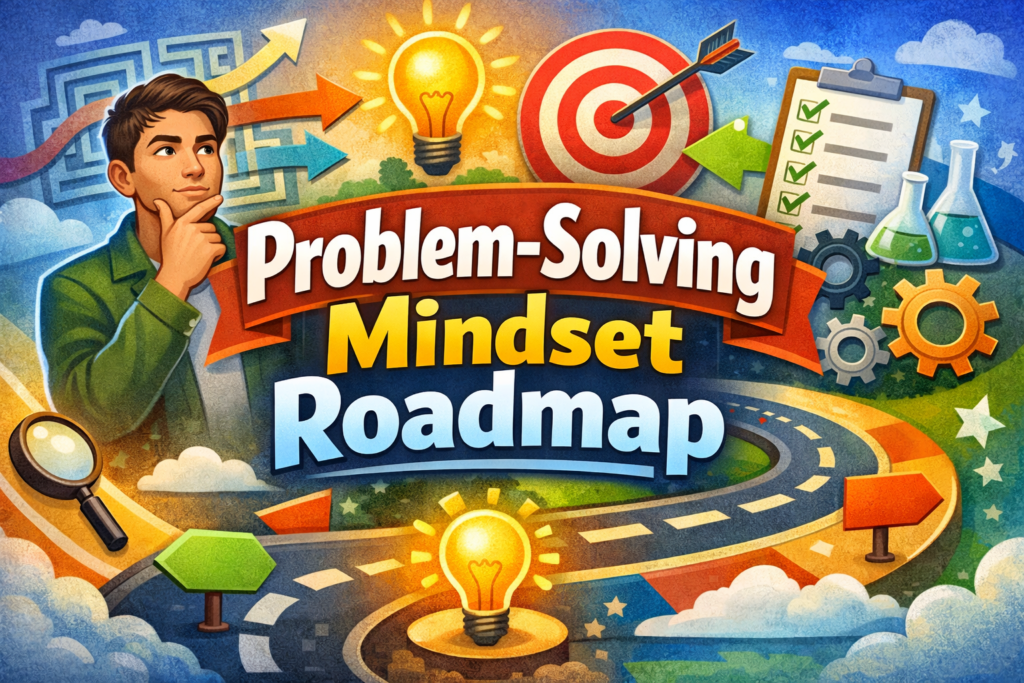
Problem-Solving Mindset Roadmap – Deep Think Version

Introduction: The Power of a Problem-Solving Mindset

A strong problem-solving mindset isn’t just about finding answers—it’s a way of thinking that turns challenges into opportunities. People with this mindset approach problems with curiosity, clarity, and creativity. They see obstacles as puzzles to solve, not barriers to stop them. Cultivating this mindset transforms decision-making, innovation, and resilience in life and work.

Step 1: Cultivate Curiosity

Why it matters: Curiosity is the foundation of critical thinking. It pushes you to explore deeper, question assumptions, and see beyond surface-level solutions.
How to develop it:

  • Ask open-ended questions constantly: “Why is this happening? What if…?”
  • Observe patterns in everyday life and analyze why things happen the way they do.
  • Keep a curiosity journal: record questions, discoveries, and insights daily.

Deep Insight: Curiosity forces your brain to explore multiple perspectives, which is essential for creative problem-solving. Without it, solutions are often superficial or reactive.

Step 2: Define the Problem Clearly

Why it matters: Most failed solutions stem from misunderstanding the problem. Clear definition narrows your focus and prevents wasted effort.
How to develop it:

  • Break the problem into smaller, manageable pieces.
  • Use frameworks like 5 Whys to uncover root causes.
  • Visualize the problem with diagrams or mind maps to see connections.

Deep Insight: A clearly defined problem often contains hints to its solution. Understanding the “why” before the “how” is the hallmark of a strategic thinker.

Step 3: Brainstorm Solutions

Why it matters: The first idea is rarely the best. Expanding your options increases the likelihood of innovative solutions.
How to develop it:

  • Generate at least 10 possible solutions without judgment.
  • Explore unconventional approaches using techniques like SCAMPER (Substitute, Combine, Adapt, Modify, Put to another use, Eliminate, Reverse).
  • Involve diverse perspectives; collaboration sparks creativity.

Deep Insight: Brainstorming is not about finding the perfect answer immediately—it’s about opening your mind to possibilities that may seem impossible at first glance.

Step 4: Evaluate and Prioritize

Why it matters: Ideas alone don’t create results; thoughtful evaluation turns potential into action.
How to develop it:

  • Assess solutions using criteria: feasibility, impact, resources, and time.
  • Use tools like decision matrices or simple pros & cons lists.
  • Prioritize high-impact, achievable solutions first, but keep innovative options for later experimentation.

Deep Insight: The best solutions balance practicality with creativity. Overanalyzing can paralyze, under-analyzing can fail—discipline in evaluation is key.

Step 5: Implement and Test

Why it matters: Execution is where ideas meet reality. Testing ensures solutions work and teaches lessons.
How to develop it:

  • Start with small-scale experiments or prototypes.
  • Track results and monitor progress carefully.
  • Iterate based on feedback; adjust strategies without fear of failure.

Deep Insight: Action teaches faster than theory. Even failed implementations reveal critical insights that refine your problem-solving approach.

Step 6: Reflect and Learn

Why it matters: Reflection transforms experience into wisdom. Without it, lessons are lost, and mistakes repeat.
How to develop it:

  • Conduct post-mortems: What worked? What didn’t? Why?
  • Maintain a “lessons-learned” log for future reference.
  • Seek feedback from mentors, peers, or team members.

Deep Insight: Reflection is the bridge between experience and mastery. Over time, it builds intuition, allowing faster and more accurate problem-solving.
Core Mindset Traits to Cultivate

  • Critical Thinking: Question, analyze, and evaluate before acting.
  • Resilience: Treat setbacks as learning opportunities.
  • Adaptability: Be flexible when solutions don’t go as planned.
  • Creativity: Approach problems with imagination and innovation.
  • Curiosity: Continuously explore, learn, and expand understanding.

Daily Practice Recommendations

  • Dedicate 15 minutes daily to analyze a small problem from a new perspective.
  • Reflect weekly on successes, failures, and alternative approaches.
  • Challenge yourself to implement at least one solution per week, no matter how small.
Problem-Solving Mindset Roadmap: Master Critical Thinking & Decision-Making

Leave a Reply

Your email address will not be published. Required fields are marked *

🎧 ARTICLE READER
🔊