















































Introduction
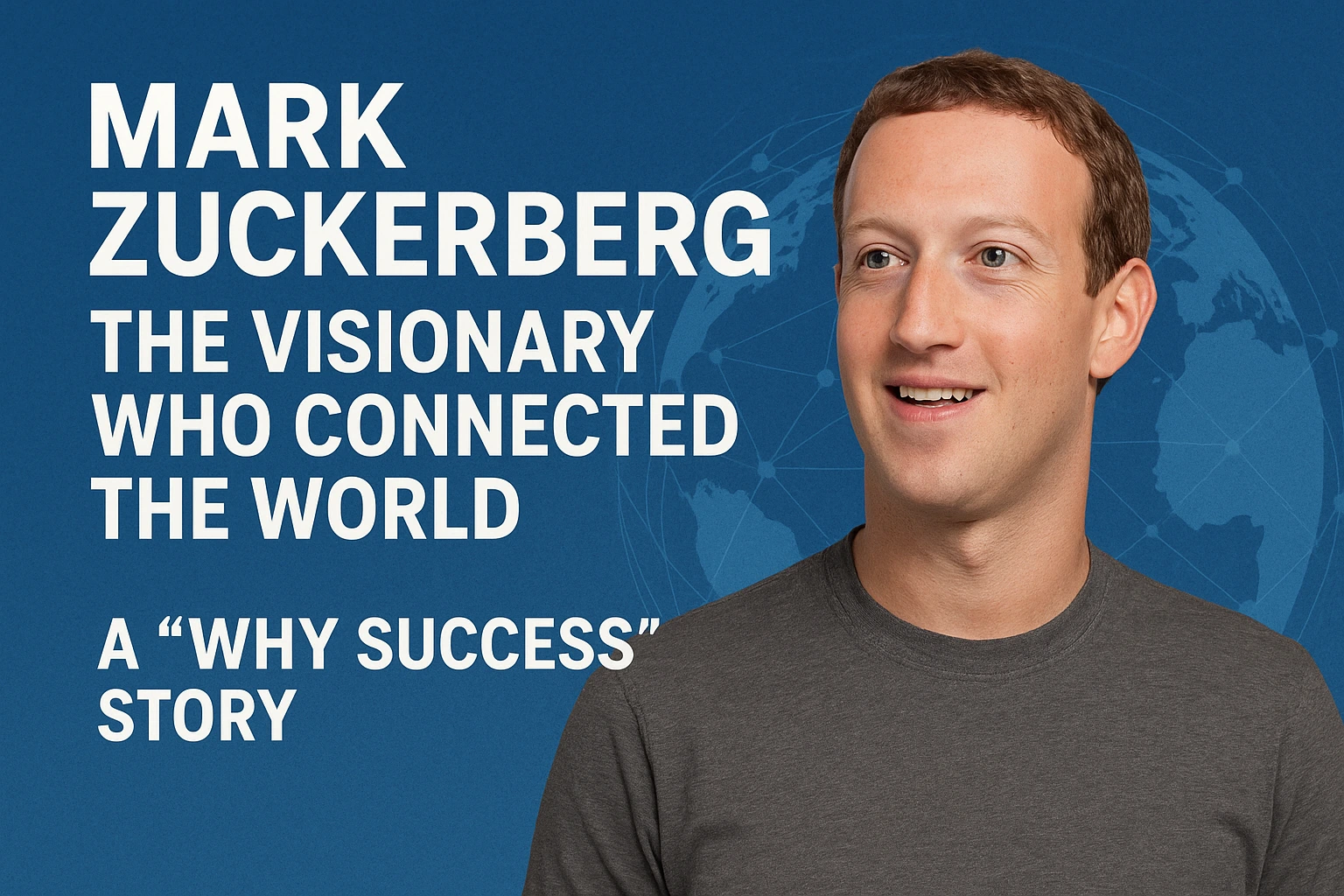
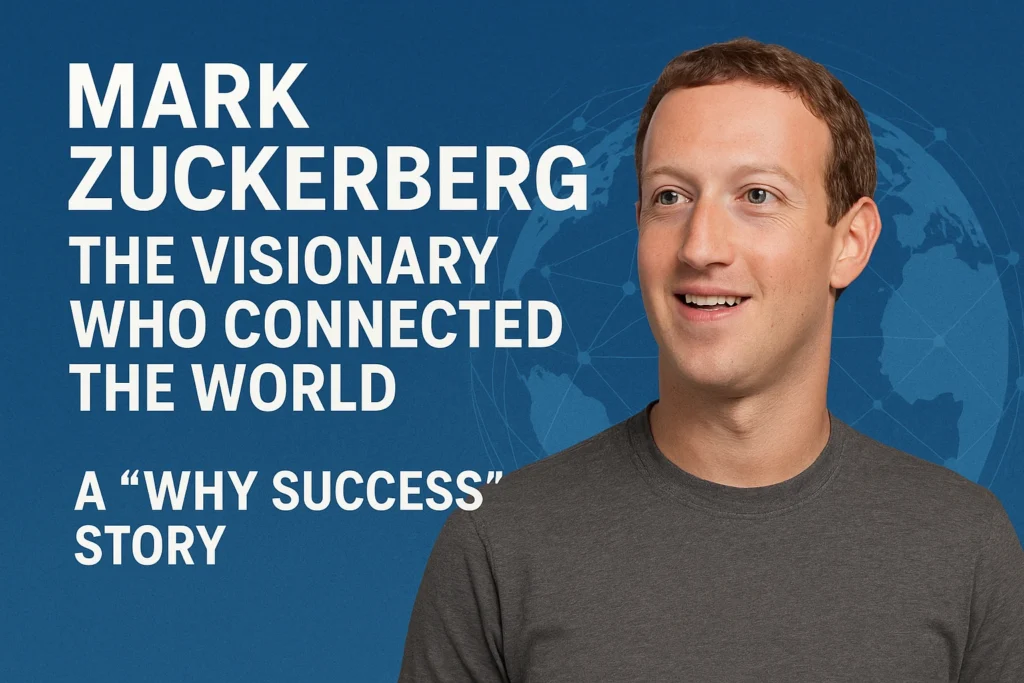
When we talk about the digital age, one name stands out — Mark Zuckerberg, the co-founder and CEO of Meta (formerly Facebook).
At just 19, he created a platform that transformed how billions of people communicate, share, and build communities online. What began as a college project in a dorm room became one of the most influential companies in the world.
But beyond fame and fortune, Zuckerberg’s journey is about vision, resilience, and evolution — turning connection into a global mission.
Through the lens of “Why Success,” we explore how Mark Zuckerberg turned an idea into a movement that changed the world — and what we can all learn from his story.
From Harvard Dorm to Global Domination
Mark Elliot Zuckerberg was born in 1984, in White Plains, New York.
From an early age, he showed exceptional talent for programming. By age 12, he had already created a messaging software called ZuckNet for his father’s dental office.
While studying at Harvard University, Zuckerberg and his friends built “TheFacebook” — a social networking site for students. What started as a small campus project quickly went viral across universities.
In 2004, Zuckerberg dropped out of Harvard to build Facebook full-time — a bold decision that would redefine how humans connect.
By his mid-20s, Zuckerberg became one of the youngest billionaires in history. But his focus was never just on money — it was on building something meaningful.
“The question I ask myself almost every day is, ‘Am I doing the most important thing I could be doing?’”
— Mark Zuckerberg
The “Why Success” Perspective: What Drives Mark Zuckerberg?
Through the Why Success lens, Zuckerberg’s story is not just about technology — it’s about purpose, adaptability, and growth.
He teaches us that success is not about starting perfect; it’s about learning fast, adapting faster, and staying true to your mission.
Here are five principles that define his journey.
1️⃣ Purpose Over Perfection
Zuckerberg didn’t wait for Facebook to be flawless — he launched, learned, and improved.
His famous motto was:
“Move fast and break things.”
For him, progress mattered more than perfection.
That mindset allowed Meta to innovate faster than competitors.
2️⃣ Building for Connection
At its heart, Facebook was never about technology — it was about people.
Zuckerberg’s mission has always been to connect the world.
Today, Meta platforms — Facebook, Instagram, WhatsApp, and Threads — connect over 3 billion users globally.
“Our mission is to give people the power to build community and bring the world closer together.”
That’s not just business. That’s impact.
3️⃣ Adaptability and Evolution
When the world shifted from desktop to mobile, Zuckerberg pivoted Facebook’s entire strategy.
When social networking changed, he embraced acquisitions — buying Instagram and WhatsApp, two of the smartest business moves of the decade.
And when the internet evolved into immersive digital experiences, he rebranded Facebook to Meta, betting on the metaverse as the future of human connection.
This adaptability is a hallmark of Why Success — seeing change not as a threat, but as an opportunity.
4️⃣ Resilience Through Criticism
Zuckerberg has faced intense public scrutiny — from privacy concerns to misinformation controversies.
Yet, through it all, he remains focused on rebuilding trust and refining his vision.
His ability to stay calm under criticism and keep learning reflects a powerful success truth:
Resilience is the fuel of reinvention.
5️⃣ Vision for the Future
Zuckerberg’s current mission goes beyond social media — he’s building the metaverse, a digital world where people can work, play, and live virtually.
“The metaverse will be the successor to the mobile internet.”
Whether it succeeds or fails, his willingness to dream big — again — shows why he remains one of the most influential innovators of our time.
Lessons from Mark Zuckerberg for Your Own “Why Success” Journey
Zuckerberg’s Principle Your Takeaway
Start Small, Think Big Every global idea begins in a small room.
Purpose Over Perfection Launch, learn, and improve continuously.
Adapt to Change The future rewards flexibility, not fear.
Stay Resilient Criticism fades; conviction endures.
Keep Dreaming Success means never running out of vision.
Beyond Business: Building the Digital Future
Zuckerberg isn’t just building products — he’s shaping how humanity interacts.
Through Meta, he’s investing billions in AI, virtual reality (VR), and augmented reality (AR) to build the next evolution of the internet.
He also emphasizes philanthropy through the Chan Zuckerberg Initiative, focusing on education, science, and equality.
For Zuckerberg, success isn’t only measured in profits — it’s measured in progress.
Final Thoughts: Why Success Means Believing in Possibility
Mark Zuckerberg’s story is proof that age, status, or starting point don’t define your destiny — vision does.
From a dorm room to the metaverse, his journey shows that success is built on curiosity, courage, and continuous growth.
Through the “Why Success” lens, we see that true leaders don’t just follow trends — they create the future.
Zuckerberg’s success isn’t about building an app.
It’s about building a world where everyone has a voice.
Why Success — The Bigger Picture
“Why Success” is not about wealth — it’s about why people do what they do, and how purpose fuels progress.
Zuckerberg’s story reminds us that success is not about creating a company, but about creating change.
Because in the end, success is not defined by what you build —
but by how many lives you connect, inspire, and empower.
Quote to Remember
“The biggest risk is not taking any risk. In a world that’s changing really quickly, the only strategy that is guaranteed to fail is not taking risks.”
— Mark Zuckerberg