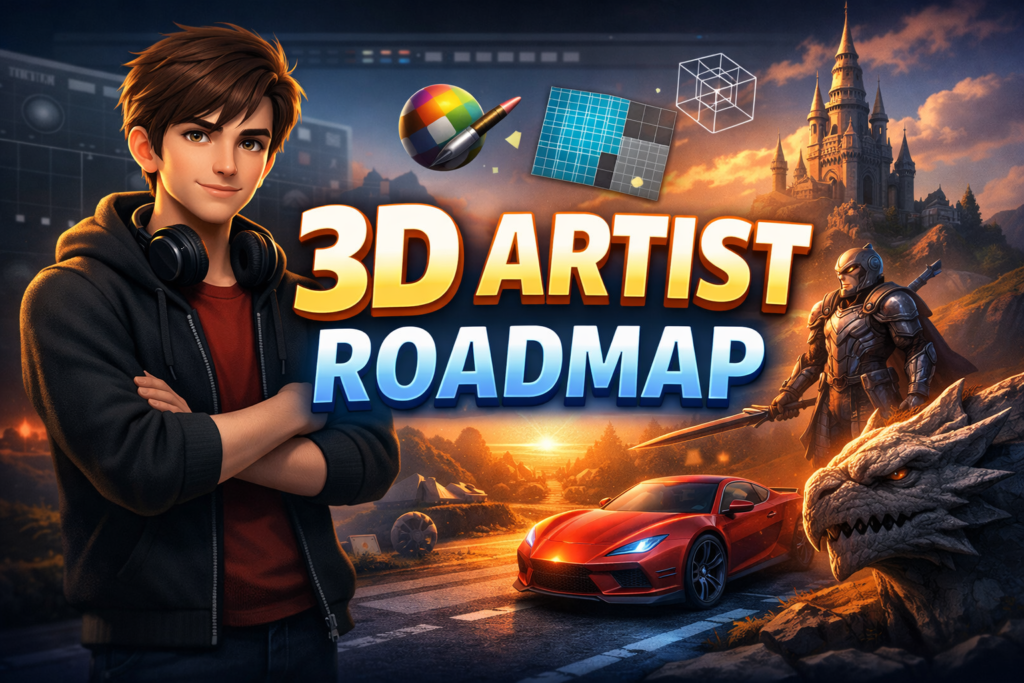
Becoming a successful 3D Artist is not about learning software first—it’s about training your eye, understanding form, and mastering workflows. This roadmap breaks the journey into clear, logical phases, so you always know what to learn, why to learn it, and how it connects to your career.
3D Artist Roadmap 2026: Complete Beginner to Professional Career Guide
Phase 1: Understanding the Foundations of 3D Art
Goal: Build a strong conceptual and artistic base before advanced tools
Most beginners rush into software. Professionals start with fundamentals.
Core 3D Concepts
What 3D actually represents in digital space
Points, edges, faces, meshes
Coordinate system (X, Y, Z)
Scale, units, and real-world dimensions
Difference between geometry, topology, and shading
Art & Visual Fundamentals
Shape language (simple to complex forms)
Proportion and balance
Color theory and material perception
Light behavior in the real world
Understanding realism vs stylization
Technical Awareness
Role of CPU, GPU, and RAM in 3D work
File formats and asset pipelines
Scene optimization mindset
👉 Outcome: You start thinking like a 3D artist, not a software operator.
Phase 2: Learning 3D Software the Right Way
Goal: Become comfortable inside one major 3D tool
Choose one primary software and go deep:
Blender
Maya
3ds Max
What to Focus On
Viewport navigation & shortcuts
Transform tools (move, rotate, scale)
Modifiers & non-destructive workflows
Scene organization & collections
Saving, exporting, and version control
👉 Outcome: You can confidently build and manage 3D scenes without confusion.
Phase 3: 3D Modeling Mastery
Goal: Create clean, production-ready models
Hard-Surface Modeling
Props, tools, vehicles, environments
Boolean vs subdivision workflows
Edge control and sharpness
Modeling from blueprints and references
Organic Modeling
Characters, creatures, natural objects
Understanding anatomy basics
Form flow and silhouette readability
Topology Fundamentals
Quads vs triangles vs n-gons
Edge flow for animation
Clean, optimized geometry
👉 Outcome: Your models are clean, editable, and usable in real projects.
Phase 4: UV Mapping & Texturing
Goal: Make models visually believable
UV Fundamentals
UV unwrapping principles
Seams, distortion, and texel density
Efficient UV layouts
Texturing Workflow
PBR texturing concepts
Texture maps: Albedo, Normal, Roughness, Metallic
Texture painting techniques
Tools: Substance Painter, Blender
Material Creation
Metals, wood, fabric, skin, plastic
Real-world material observation
Stylized vs realistic materials
👉 Outcome: Your models look professional, not flat or artificial.
Phase 5: Lighting & Rendering for Impact
Goal: Present your work like a pro
Lighting Fundamentals
Three-point lighting
HDRI environment lighting
Mood, contrast, and storytelling
Rendering Knowledge
Real-time vs offline rendering
Render engines (Cycles, Eevee, Arnold, V-Ray)
Noise control and optimization
Camera composition & framing
👉 Outcome: Your renders feel cinematic, clean, and portfolio-ready.
Phase 6: Digital Sculpting & High-Detail Work
Goal: Add realism and artistic depth
Sculpting tools & brushes
Anatomy and surface detailing
High-poly sculpt creation
Retopology for production
Baking normal maps
👉 Outcome: You can create detailed characters and assets for games or films.
Phase 7: Animation & Motion Basics
Goal: Understand movement and life in 3D
Keyframe animation
Timing and spacing
Basic rigging principles
Simple character and object animation
Physics simulations (cloth, rigid bodies)
👉 Outcome: You understand how 3D assets behave in motion.
Phase 8: Choose Your 3D Specialization
Goal: Build career-focused expertise
Career Paths
🎮 Game Artist (low-poly, engines, optimization)
🎬 VFX / Film Artist (high-quality realism)
🏗️ Architectural Visualization Artist
🧑🎨 Character Artist
📦 Product & Motion Graphics Artist
👉 Outcome: You stop being a general learner and start becoming a specialist.
Phase 9: Portfolio Development
Goal: Show skill, not certificates
5–10 strong projects
Process breakdowns
Wireframes and texture maps
Consistent visual style
Platforms: ArtStation, Behance, personal site
👉 Outcome: Your work speaks before you do.
Phase 10: Professional & Career Growth
Goal: Turn skill into income
Freelancing fundamentals
Studio workflows
Client communication
Time management & feedback handling
Networking and continuous learning
👉 Outcome: You grow as both an artist and a professional.
Final Thought
A great 3D Artist is a mix of artist, technician, and problem solver. Follow this roadmap step by step, focus on quality over speed, and your growth will be steady, confident, and career-ready.