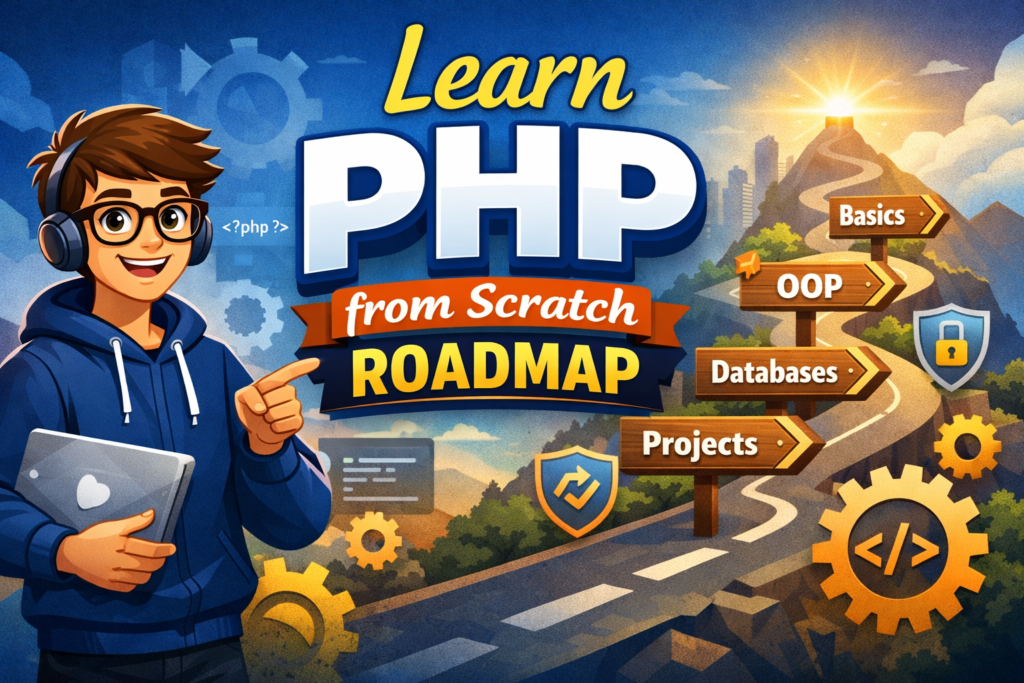
 Learn PHP from Scratch Roadmap – Step-by-Step Guide for Beginners to Advanced
Stage 1: Foundations – Understanding PHP and Its Ecosystem
Goal: Grasp what PHP is, why it exists, and how it fits into web development.
- Conceptual Understanding
- PHP as a server-side scripting language.
- The difference between frontend, backend, and full-stack roles.
- Understanding LAMP/WAMP/MAMP stacks.
- Setup & First Script
- Install local server environment: XAMPP/WAMP/MAMP.
- Install and configure VS Code or PHPStorm.
- Run your first PHP script: <?php echo “Hello World”; ?>.
- Mindset
- Think like a backend developer: requests, responses, sessions.
- Understand the lifecycle of a PHP script on the server.
Stage 2: Core Syntax and Basics
Goal: Learn PHP’s language fundamentals thoroughly.
- Variables & Data Types
- Dynamic typing in PHP.
- Scalar types: integer, float, string, boolean.
- Complex types: arrays, objects, NULL.
- Operators
- Arithmetic, logical, comparison, string concatenation.
- Output & Debugging
- echo, print, print_r(), var_dump().
- Debugging mindset: understanding errors, reading warnings.
- Best Practices
- Naming conventions.
- Code readability and commenting.
Stage 3: Control Structures & Logic Building
Goal: Develop logical thinking and control flow mastery.
- Conditional Statements
- if, else, elseif, switch.
- Loops
- for, foreach, while, do-while.
- Deep Thinking
- How to break problems into conditional steps.
- Loop optimization and thinking about performance.
- Error Handling Basics
- error_reporting(), die(), try-catch.
Stage 4: Functions – Modular Thinking
Goal: Write reusable, modular code and understand scope.
- User-defined Functions
- Defining, calling, parameters, return values.
- Variable Scope
- Local vs global, static variables.
- Built-in Functions
- Strings, arrays, date/time.
- Anonymous Functions & Closures
- Passing functions as arguments.
- Mindset
- Think in “functional blocks” instead of linear scripts.
Stage 5: Arrays & Data Structures
Goal: Learn to store, manipulate, and traverse complex data.
- Types of Arrays
- Indexed, associative, multidimensional.
- Array Operations
- Sorting, filtering, merging, searching.
- Superglobals
- $_GET, $_POST, $_SESSION, $_COOKIE.
- Deep Understanding
- Choose the right data structure for the problem.
- Think about efficiency and memory usage.
Stage 6: Object-Oriented PHP
Goal: Transition to scalable, maintainable code with OOP principles.
- Core Concepts
- Classes, objects, properties, methods.
- Constructors & destructors.
- Advanced Concepts
- Inheritance, polymorphism, encapsulation.
- Abstract classes, interfaces, traits.
- Mindset
- Model real-world entities in code.
- Separate responsibilities and promote code reuse.
Stage 7: Forms, Input, and Session Management
Goal: Learn to interact with users and manage state.
- Forms
- GET vs POST methods.
- Input validation and sanitization.
- Sessions & Cookies
- Session lifecycle, persistent user state.
- Security considerations.
- File Upload Handling
- Accept files, validate types/sizes, store securely.
Stage 8: Database Integration
Goal: Connect PHP to databases and perform CRUD operations.
- MySQL Basics
- Tables, columns, primary/foreign keys.
- PHP Database Interaction
- mysqli and PDO connections.
- CRUD operations with prepared statements.
- Deep Thinking
- Prevent SQL injection.
- Optimize queries for performance.
- Mindset
- Think relationally: data normalization, relationships.
Stage 9: Advanced PHP Concepts
Goal: Master professional-level PHP features and patterns.
- Error & Exception Handling
- Namespaces & Autoloading
- Organize code for large projects.
- Regular Expressions
- Validate patterns like emails, phone numbers.
- File Handling
- Read/write files, parse CSV/JSON.
- PHP with JSON
- Encode/decode, API data exchange.
- Mindset
- Anticipate errors, structure code for maintainability.
Stage 10: Frameworks and Architecture
Goal: Move beyond plain PHP into professional development.
- MVC Architecture
- Understanding Models, Views, Controllers.
- Frameworks
- Laravel or Symfony basics.
- Routing, templating, ORM (Eloquent).
- Mindset
- Separation of concerns: code structure, scalability, maintainability.
Stage 11: Security and Best Practices
Goal: Write secure and production-ready PHP code.
- Input validation and sanitization.
- Password hashing & verification (password_hash() / password_verify()).
- Prevent XSS, CSRF, SQL injection.
- Session and cookie security.
- Mindset: “Assume everything can be malicious.”
Stage 12: Project-Based Mastery
Goal: Cement knowledge with practical, real-world projects.
- Beginner
- To-Do List, Contact Form, Calculator.
- Intermediate
- User Authentication System, Blog CRUD.
- Advanced
- E-commerce backend, REST API with JWT.
- Deep Thinking
- Apply concepts, optimize structure, secure code, handle edge cases.
Stage 13: Deployment & Real-World Practices
- Hosting on shared servers or VPS.
- FTP/Git deployment.
- .htaccess configuration.
- Environment variables and configuration management.
- Think like a professional developer: maintainable, version-controlled, secure deployments.
Stage 14: Continuous Learning & Growth
- Keep updated with PHP updates and community trends.
- Contribute to open-source PHP projects.
- Learn related technologies: HTML, CSS, JavaScript, APIs, Laravel advanced features.
- Deep mindset: Always iterate, refactor, and challenge yourself with complex projects.
Learn PHP from Scratch Roadmap – Step-by-Step Guide for Beginners to Advanced
Reader: 159