Stage 1: Foundations – Build the Mental Model of JavaScript
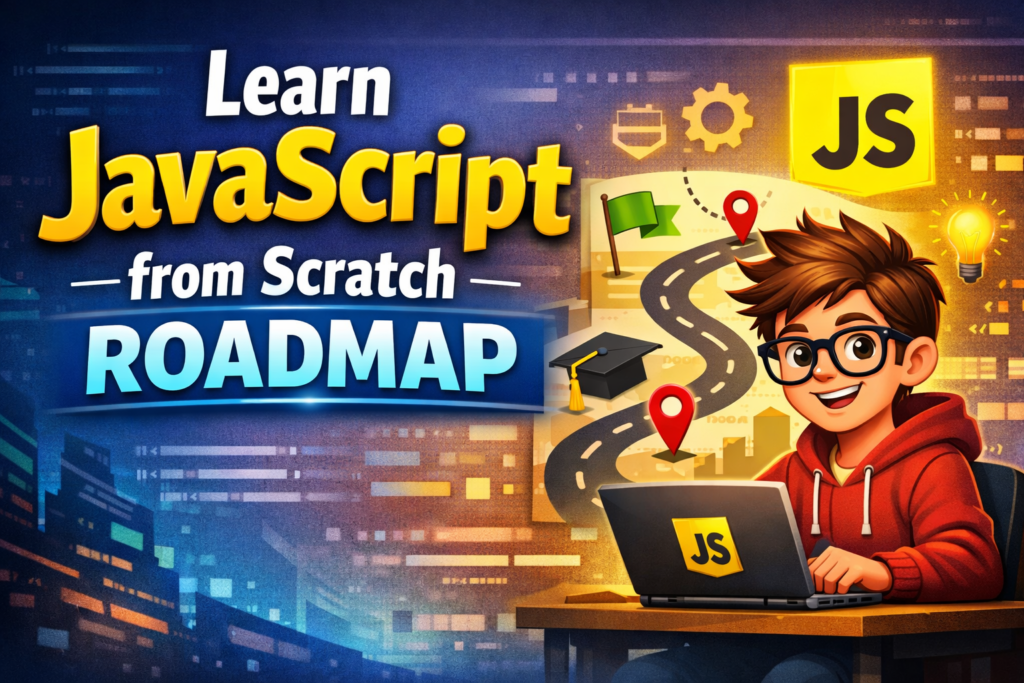 Learn JavaScript from Scratch – Step-by-Step Roadmap
Objective: Understand the essence of JavaScript and how it thinks.
Focus Areas:
- What JavaScript Really Is: Dynamic, interpreted language; client-side and server-side roles.
- Setting Up Your Environment: Browser DevTools, VS Code, Node.js – understand their purpose.
- Core Syntax: Variables (let, const), data types, operators.
- Logic Foundations: Conditional statements and Boolean logic.
- Practice: Tiny experiments like manipulating numbers and strings, testing comparisons.
Deep Insight: At this stage, you’re training your brain to think in JavaScript logic, not just memorize commands.
Milestone: Write a “mini lab” with console-based interactive exercises (calculator, greetings, age checker).
Stage 2: Control Flow & Loops – Thinking in Decisions and Repetition
Objective: Learn to model logic and repetition like a programmer.
Focus Areas:
- Decision Making: if/else, switch – understand branching like a flowchart.
- Iteration: Loops (for, while) as a tool to automate repetitive thought.
- Edge Cases: Using break and continue wisely.
- Practice: Build small logic-based programs (number guessing game, simple score tracker).
Deep Insight: Mastering loops and conditionals trains you to model real-world scenarios in code, which is core to problem-solving in programming.
Stage 3: Functions & Modular Thinking – Break Problems Into Reusable Parts
Objective: Learn to encapsulate logic and reuse it efficiently.
Focus Areas:
- Function Basics: Declaration, expression, arrow functions.
- Parameters and Return Values: Think of functions as machines: input → process → output.
- Scope & Closures: Understand local vs global contexts.
- Callback Functions: Start exploring asynchronous thinking.
- Practice: Build modular tools, like a calculator or task organizer with reusable functions.
Deep Insight: Functions teach you structured thinking—a skill that transcends programming.
Stage 4: Data Structures – Arrays & Objects – Organize Complexity
Objective: Manage and manipulate collections of information effectively.
Focus Areas:
- Arrays: Store ordered data, iterate efficiently.
- Objects: Represent real-world entities and relationships.
- Advanced Operations: map, filter, reduce, destructuring, nested structures.
- Practice: Build a contact manager or a student record system.
Deep Insight: Data structures are the backbone of problem-solving; mastering them trains you to simplify complexity.
Stage 5: DOM Manipulation – Make JavaScript Interactive
Objective: Bridge JavaScript with the real-world interface of a web page.
Focus Areas:
- DOM Hierarchy: Understand nodes, elements, and the document structure.
- Selecting & Manipulating Elements: querySelector, getElementById, innerHTML, style.
- Event Handling: Clicks, inputs, hover – triggering behavior dynamically.
- Practice: Build interactive apps like to-do lists, dynamic quizzes, or live calculators.
Deep Insight: The DOM stage teaches cause-and-effect thinking in programming: actions trigger reactions, just like in real systems.
Stage 6: Advanced JavaScript – Modern Patterns and Efficient Thinking
Objective: Write clean, modern, and maintainable code.
Focus Areas:
- ES6+ Features: Template literals, spread/rest, destructuring, default parameters.
- Error Handling: try/catch – anticipate and manage unexpected situations.
- Modules: Organize code across files for clarity and scalability.
- Practice: Refactor old projects using ES6 syntax and modular design.
Deep Insight: Advanced features shift you from a coder to a software thinker, capable of building maintainable systems.
Stage 7: Asynchronous JavaScript – Handling the Real World
Objective: Master APIs, timing, and external data flow.
Focus Areas:
- Asynchronous Concepts: Callbacks, promises, async/await.
- Fetching Data: Working with REST APIs, parsing JSON.
- Error Handling: Anticipating failures in async operations.
- Practice: Build apps that fetch weather data, user profiles, or live content.
Deep Insight: Asynchronous programming teaches patience and sequence thinking—critical for large, real-world applications.
Stage 8: Projects – Integrate, Innovate, and Internalize
Objective: Apply all learned skills in realistic scenarios.
Suggested Projects:
- To-Do List with local storage
- Quiz App with dynamic scoring
- Weather App using a public API
- Personal Portfolio Website
Deep Insight: Projects solidify knowledge by forcing integration of concepts, promoting long-term retention and confidence.
Stage 9: Beyond Basics – Continuous Mastery
Tips for Deep Learning:
- Daily small coding challenges (e.g., 30 min/day on Codewars or LeetCode)
- Refactor and optimize your own projects regularly
- Explore open-source JavaScript projects
- Join developer communities to exchange ideas
- Gradually learn frameworks like React or Node.js once core mastery is achieved
Mindset: Learning JavaScript is not linear—mastery comes from practice, reflection, and real-world application.
Reader: 111